How to Count Calories in Indian Home-Cooked Food: Roti, Dal, Sabzi, Rice
18 min read
Lunch is two rotis, a katori of dal, bhindi sabzi and curd. Someone else cooked it, in pots meant for five. You open a calorie app, type "dal" and get a list of other people's dals.
To count calories in Indian home-cooked food, count what went into the pot, raw: the atta, rice, dal and vegetables, and every spoon of oil and ghee. Look each one up in ICMR-NIN's Indian Food Composition Tables 2017 (IFCT 2017, read on 12 November 2026), add them up, then divide by the number of rotis or katoris. On those figures, a medium roti made from 30 g of atta is about 96 kcal, a katori of rice from 50 g of raw rice about 178 kcal, and a katori of dal from 30 g of raw toor dal about 99 kcal before the tadka. Each teaspoon of oil or ghee adds 45 kcal, and the oil is the part that moves the answer most.
This post covers why app entries miss, the sums for each dish, a reference table, what to do when someone else cooks, and a whole thali.
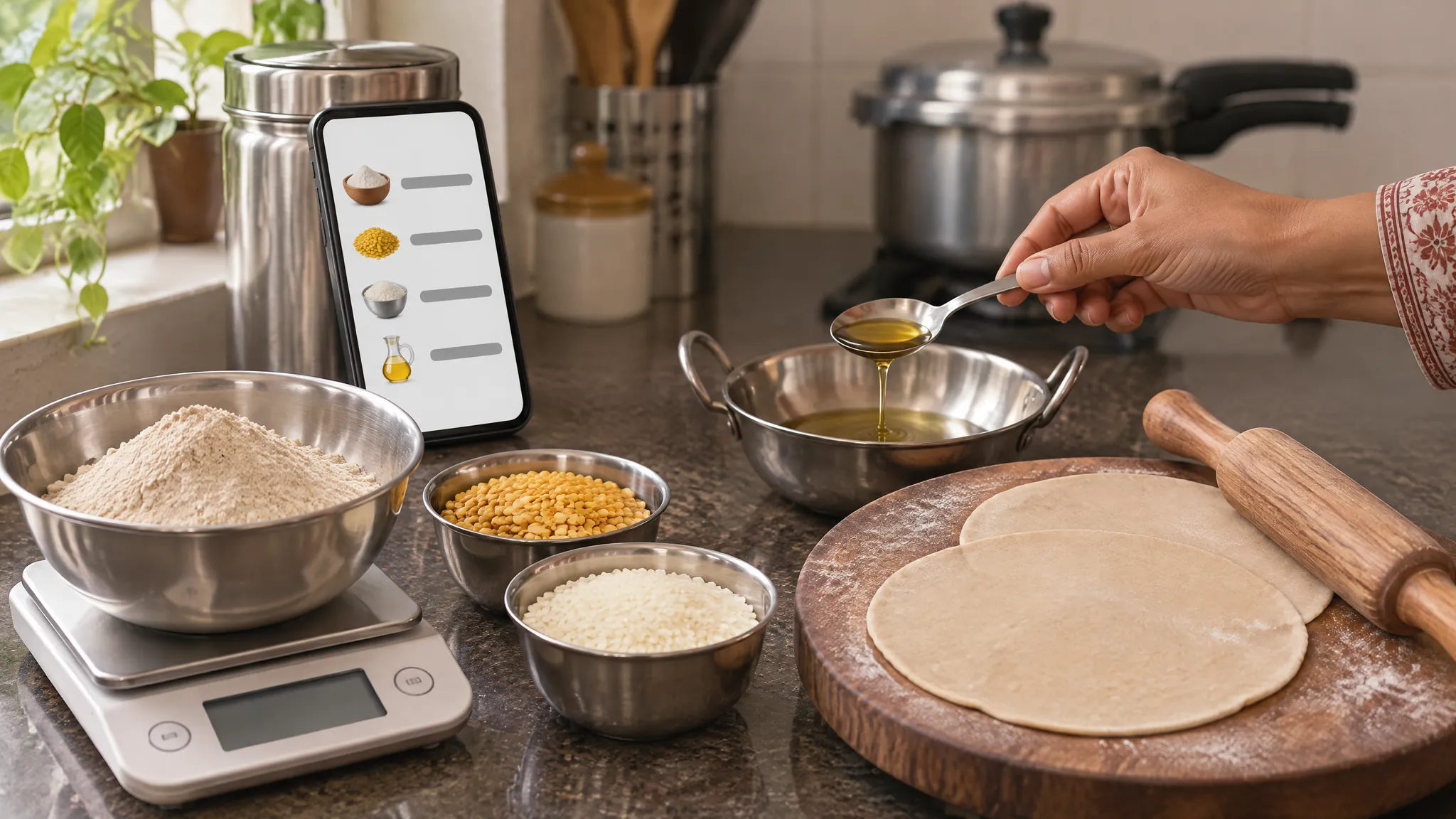
Why a generic entry for dal or sabzi can be far from yours
India's official food tables can't tell you what's in your dal either. IFCT 2017, from India's National Institute of Nutrition (ICMR-NIN), covers 528 foods, almost all of them raw. A 2024 paper on Indian recipe data notes that it "does not include data for composite dishes, i.e., chapattis or curries".
So every "dal, 1 katori" in an app or a chart is somebody's recipe: an assumed amount of dal, water and ghee. On IFCT's value for toor dal, a katori can be 66 kcal (thin, no tadka) or 177 (thick, with a teaspoon of ghee).
The same happens to the whole plate. A home thali of two rotis, dal, rice, bhindi sabzi, curd and salad is about 600 kcal before any oil or ghee. Cooked with 5 g of oil and ghee it is 645 kcal, with 15 g it is 735 and with 30 g it is 870 (the sums are in the thali section). That's 225 kcal, or 35% more, for the same food. A database entry can't know which kitchen is yours. The person who cooked can.
How to calculate calories in Indian food, dish by dish
This applies the method in how to count calories in homemade food and recipes to an Indian kitchen. That post covers the general steps, raw and cooked weights, and weighing the finished pot. The ground rules here:
- Values are IFCT 2017's, per 100 g of raw food. IFCT prints kilojoules, and this post divides by 4.184. (The general post divides by 4.18, IFCT's own rounding. The gap is never more than 1 kcal per 100 g.)
- Oil, ghee and sugar are not in IFCT's energy table, so they follow ICMR-NIN's guidelines: 900 kcal per 100 g for oil and ghee, which is 45 kcal a 5 g teaspoon, and 400 for sugar, 20 kcal a teaspoon. (USDA's teaspoon of oil, used in the general post, is 4.5 g and about 40 kcal.)
- A katori is 200 ml, the size in ICMR-NIN's diet charts. Katoris vary, so measure yours (see below).
- Portion sizes and oil amounts are kitchen approximations. "Low oil" is ½ teaspoon per person per dish, "typical" 1 and "generous" 2. We found no published measurement of the oil in a home tadka or sabzi. A teaspoon in each of six cooked dishes a day is 30 g, close to the 29.5 g of visible fat a day that ICMR-NIN's What India Eats report found urban adults eating.
- Water, salt and spices are not counted.
IFCT 2017's Table 1 (read on 12 November 2026), converted to kcal, gives these values per 100 g, raw: atta 320.3, white rice 356.4, toor dal 330.8, moong dal 325.8, masoor dal 322.4, chana dal 329.1, urad dal 324.1, potato 69.8, onion 48.0, bhindi 27.5, cauliflower 22.9, tomato 18.9, cucumber 17.4, lauki 11.0, whole cow's milk 72.9 and whole buffalo milk 107.3. Each sum below multiplies grams by kcal per 100 g and divides by 100, rounded to the nearest kcal.
Roti, phulka and paratha
A roti's calories are its atta plus any fat. Water adds weight, not calories. So find out how much atta goes into the dough and how many rotis it makes. If 300 g of atta makes 10 rotis:
- 300 g × 320.3 ÷ 100 = 961 kcal for the dough
- 961 ÷ 10 = 96 kcal a roti, from 30 g of atta each
- Ghee on top: ½ teaspoon (2.5 g) adds 22.5 kcal and a full teaspoon 45, making 119 or 141 kcal
"One roti" is not one size. A 2025 diet plan for Indian heart patients counts a roti as 20 g of atta. ICMR-NIN's 2011 list gives a phulka 80 kcal, which is 25 g. A 2011 review of grains in Indian diets gets two to four chapatis from 100 g of flour, 25 to 50 g each. So these are working sizes, a kitchen approximation: a small phulka from 20 g of atta is 64 kcal, a medium roti from 30 g is 96 and a large one from 40 g is 128. Weigh your household's atta once.
A plain paratha from 50 g of atta is 205 kcal with 1 teaspoon of oil or ghee and 250 with 2. Add any filling the same way.
Rice
Count rice raw. If 200 g of raw rice is cooked for four:
- 200 g × 356.4 ÷ 100 = 713 kcal in the pot
- 713 ÷ 4 = 178 kcal each, from 50 g of raw rice
Cooked, that 50 g weighs about 140 g, which slightly heaps a 200 ml katori. That assumes cooked rice weighs 2.8 times its raw weight, a USDA-based figure from the general post (checked 14 October 2026). We couldn't find a published measurement for rice cooked in Indian homes.
At that yield, cooked rice is about 127 kcal per 100 g (USDA lists 130). A level 200 ml katori holds roughly 130 to 135 g: about 47 g of raw rice and 168 kcal. ICMR-NIN's 2011 list rounds a 200 ml cup of cooked rice to 170.
Dal
Count the raw dal, then the tadka. For a pot that serves four:
- 120 g of raw toor dal × 330.8 ÷ 100 = 397 kcal
- A tadka with 4 teaspoons (20 g) of ghee: 20 × 9 = 180 kcal
- Pot total 577 kcal, so 144 kcal a katori: 99 from 30 g of dal and 45 from a teaspoon of ghee
Which dal you use hardly matters: 30 g of raw moong dal is 98 kcal, masoor 97, chana dal 99 and urad 97. Nor do the onion and tomato: 20 g of tomato and 15 g of onion add 11 kcal. What decides the number is how thick the dal is (how much raw dal ends up in your katori) and how much fat goes into the tadka:
| Raw toor dal in one katori | No tadka | ½ tsp fat | 1 tsp fat | 2 tsp fat |
|---|---|---|---|---|
| 20 g (thin dal) | 66 | 89 | 111 | 156 |
| 30 g (this post's katori) | 99 | 122 | 144 | 189 |
| 40 g (thick dal) | 132 | 155 | 177 | 222 |
The range comes from ICMR-NIN's 2011 sample menus, which turn 20 g of raw pulses into half a 200 ml cup of dal (40 g a cup), and the 2025 diet plan, which counts 30 g as one and a half katoris of medium-thick dal (20 g a katori). This post uses the midpoint, 30 g, as a kitchen approximation.
Thickness also makes "per 100 g" figures for cooked dal slippery: 30 g of raw dal is 66 kcal per 100 g if it cooks to 150 g and 44 if it cooks to 225 g.
Sabzi
A sabzi is vegetables plus oil, and the oil is often the bigger half. Bhindi for four, with trimmed raw weights:
- 400 g of bhindi and 100 g of onion: 158 kcal
- 4 teaspoons (20 g) of oil: 180 kcal
- Pot total 338 kcal, so 84.5 kcal a serving: 39.5 from the vegetables and 45, or 53%, from the oil
With ½ teaspoon of oil a serving, the same bhindi is 62 kcal, and with 2 teaspoons it is 129.5. The vegetables matter less: a serving of aloo gobi (50 g potato, 100 g cauliflower, 25 g tomato, 20 g onion) is 72 kcal before oil, and a serving of lauki (150 g lauki, 25 g tomato, 15 g onion) is 28. Egg, chicken, fish and mutton curries work the same way.
Curd and milk
IFCT 2017 lists whole cow's milk and whole buffalo milk, but no curd.
- Home-set curd: this post counts it as the milk it was set from, a kitchen approximation. ICMR-NIN's 2024 plate does much the same, counting 300 ml of milk or curd as about 216 kcal, or 72 per 100 ml. So 100 g of curd set from whole cow's milk is about 73 kcal, and a 150 g katori about 109.
- A glass of milk: 200 g of whole cow's milk is 146 kcal, and of whole buffalo milk 215.
- Packaged milk and dahi: use the figure on the pack.
Chai with milk and sugar
Tea leaves and water don't count. The milk and sugar do.
- 75 g of whole cow's milk × 72.9 ÷ 100 = 55 kcal
- 1 teaspoon (5 g) of sugar = 20 kcal
- One cup: 75 kcal. A second teaspoon of sugar makes it 95.
Three cups a day at 75 kcal each is 225 kcal, more than two rotis. Measure once how much milk goes into the pan and how many cups it makes.
What IFCT 2017 doesn't list
We searched the full text of IFCT 2017 on 12 November 2026. Its foods are raw ingredients (the preface names eggs as the only exception), so it has no roti, cooked rice, cooked dal or sabzi. It also has no curd, toned or skimmed milk, white sugar or besan, and no energy value for oils or ghee, hence the stand-ins above. For besan, use chana dal (329.1 kcal per 100 g), the nearest entry: a kitchen approximation.
Calories in homemade roti, dal, sabzi and rice: a reference table
These are the figures from the sums above, for a quick log. Every row states what it assumes.
| Food | Assumes | kcal |
|---|---|---|
| 1 medium roti | 30 g atta, no ghee | 96 |
| 1 small phulka | 20 g atta, no ghee | 64 |
| 1 large roti | 40 g atta, no ghee | 128 |
| 1 plain paratha | 50 g atta, 2 tsp (10 g) oil or ghee | 250 |
| 1 katori cooked rice | 50 g raw rice, about 140 g cooked | 178 |
| 1 katori dal, no tadka | 30 g raw toor dal | 99 |
| 1 katori dal with tadka | 30 g raw toor dal, 1 tsp ghee or oil | 144 |
| 1 serving bhindi sabzi | 100 g bhindi, 25 g onion, 1 tsp oil | 85 |
| 1 serving aloo gobi | 50 g potato, 100 g cauliflower, 25 g tomato, 20 g onion, 1 tsp oil | 117 |
| 1 serving lauki sabzi | 150 g lauki, 25 g tomato, 15 g onion, 1 tsp oil | 73 |
| 100 g curd | Set from whole cow's milk | 73 |
| 1 cup chai | 75 g whole cow's milk, 1 tsp sugar | 75 |
| 1 tsp oil or ghee | 5 g | 45 |
Katori: 200 ml. Values: IFCT 2017 per 100 g raw, with oil, ghee and sugar from ICMR-NIN, worked out on 12 November 2026. ICMR-NIN's 2011 menus treat 100 g of raw vegetables as half a 200 ml cup of sabzi, so the bhindi serving is a little over half a katori and the others close to a full one.
How to track calories of home-cooked food when someone else cooks
You didn't cook it, and you only eat part of it. Most of the work is done once, so nobody has to weigh anything every day.
Ask four questions, once
- How much atta goes into the dough, and how many rotis does it make?
- How much raw rice and raw dal go in, and for how many people?
- How many spoons of oil or ghee go into the tadka, each sabzi and onto the rotis?
- How many katoris does each pot fill?
The answers will come in cups and fistfuls, not grams. Turn the cook's measure into grams once: count how many of the cook's cups a fresh 1 kg packet of dal or rice fills. If it fills five, a cup is 200 g. Check the oil spoon against a 5 ml measuring spoon too.
Work out your share of the pot
Rotis are simple: count them. For dal, sabzi and rice, your share is the katoris you ate divided by the katoris the pot fills.
Say the dal for five people uses 150 g of raw toor dal and 5 teaspoons (25 g) of ghee. That is 496 + 225 = 721 kcal in the pot. If the pot fills six of your katoris, one katori is 120 kcal and a katori and a half is 180. If nobody knows how many katoris a pot fills, divide by the number of people eating and adjust for how much you eat compared with the others.
Measure your own katori once
"One katori" is not one size. ICMR-NIN's own measuring set has four, of 115, 155, 200 and 360 ml. Fill yours with water to where the dal usually comes and pour it into a measuring jug, or count how many times a 500 ml bottle fills it: two and a half times means 200 ml. How to track calories without a food scale has the full method.
Count the oil by the bottle
If nobody can tell you the spoons, the bottle can. This is a kitchen approximation, not a measurement.
Note the day a new bottle or pouch of cooking oil is opened and the day it is empty. A litre of oil weighs roughly 900 g (USDA puts a 15 ml tablespoon of olive oil at 13.5 g; if your pack prints a net weight in grams, use that). Divide by the days it lasted, then by the number of people eating. A litre that lasts four people 15 days is 900 ÷ 15 ÷ 4 = 15 g each a day: three teaspoons, or 135 kcal. Do the same for the ghee jar.
It is rough: it assumes everyone eats an equal share, it counts oil nobody ate (such as oil thrown away after deep-frying), and it can't tell you which dish the oil went into. So use it either as a check on your spoon counts, or by logging dal and sabzi without fat and adding the day's oil as a single line. Not both.
If you can't ask at all, as in a hostel mess or a PG, use the reference table as it stands and treat the total as an estimate.
Calories in a homemade Indian thali, worked through
This is the thali from the top of the post.
| Item | Raw amount | kcal |
|---|---|---|
| 2 medium rotis | 60 g atta | 192 |
| 1 katori dal | 30 g toor dal | 99 |
| 1 katori rice | 50 g raw rice | 178 |
| Bhindi sabzi, vegetables only | 100 g bhindi, 25 g onion | 40 |
| Curd | 100 g, counted as whole cow's milk | 73 |
| Salad | 50 g cucumber, 50 g tomato | 18 |
| Before added fat | 600 | |
| With low oil | 5 g: ½ tsp each in tadka and sabzi, dry rotis | 645 |
| With typical oil | 15 g: 1 tsp each in tadka and sabzi, ½ tsp ghee per roti | 735 |
| With generous oil | 30 g: 2 tsp each in tadka and sabzi, 1 tsp ghee per roti | 870 |
Worked out on 12 November 2026 from the IFCT 2017 values above, with fat at 45 kcal a teaspoon.
What changes the total most, in order:
- The oil and ghee. They run from 45 to 270 kcal on the same food: 7% of the low-oil plate and 31% of the generous one. The generous version's 30 g is ICMR-NIN's whole-day limit for visible fat (cooking oil, ghee and butter) for a sedentary man. For a sedentary woman it is 20 g.
- The rotis and rice. Together they are half of the typical thali, 370 of 735 kcal. A third roti with ghee adds 119 kcal, and a second katori of rice 178.
- How thick the dal is. A thin katori is 66 kcal and a thick one 132, before the tadka.
- Which sabzi. Aloo gobi instead of bhindi adds 33 kcal before oil.
How precise do you need to be?
The one-off sums are worth doing if you eat home food most days, because one set of numbers then covers most of your log, or if your log and your weight disagree. Two thalis a day that are each 225 kcal above what you logged come to 450 kcal, most of the 500 to 750 kcal a day that ICMR-NIN describes as a typical weight-loss deficit.
A rough count is fine if you want the broad picture or your meals are steady. Count rotis and katoris, use the reference table and log the same way every day. A steady error shows up in your weekly weight trend, and you can correct for it.
Get professional advice first if you manage diabetes, kidney disease or another condition through diet, are pregnant or breastfeeding, are under 18, or have a history of disordered eating. Talk to a doctor or registered dietitian before you count or cut calories. The figures here are general wellness information, not medical advice: see the medical disclaimer.
How to log home-cooked food without redoing the sums
Do the sums once for each dish and save the result under a name that states its assumptions, such as "Home dal, 1 katori, 30 g toor, 1 tsp ghee". An app that divides a recipe for you suits the pot method best: Cronometer's recipes can be split by servings or by a cooked weight you enter (help centre read on 12 November 2026).
VitalityApp, which publishes this blog, takes a typed line such as "2 roti, 1 katori dal, bhindi sabzi, curd" and returns an AI estimate for each item. That is an estimate, not a calculation from your pot, so correct it with your own grams: you can change each food or its grams before you save. A custom meal is saved as one portion, with no setting to divide a pot by servings or cooked weight, so build it from one person's share and re-log it from My Saved Meals, which is on the free plan (the steps are in the general post).
Frequently asked questions
How many calories are in one homemade roti? About 96 kcal for a medium roti made from 30 g of atta with no ghee. A small 20 g phulka is about 64 kcal, a large 40 g roti about 128, and each teaspoon of ghee adds 45.
How many calories are in one katori of homemade dal? About 99 kcal from 30 g of raw toor dal before the tadka, and about 144 with a teaspoon of ghee or oil. A thin dal can be 66 kcal a katori, and a thick one with a teaspoon of ghee 177.
How many calories are in a homemade Indian thali? Two rotis, dal, rice, bhindi sabzi, curd and salad are about 600 kcal before added fat: 645 kcal with 5 g of oil and ghee, 735 with 15 g and 870 with 30 g.
Should I count rice and dal raw or cooked? Raw, if you can find out the amounts: the water rice and dal absorb changes their weight but not their calories. Cooked rice is about 127 kcal per 100 g. Cooked dal varies too much with thickness for one figure to work.
How do I count calories when someone else cooks? Ask once how much atta, rice, dal and oil go in, and for how many people, then count your rotis and katoris each day. For the oil, divide a finished bottle by the days it lasted and the people eating.
Keep reading
- How to count calories in homemade food and recipes: the general method.
- Indian calorie deficit diet chart: 1,500 and 1,800 kcal day charts, veg and non-veg.
- How to track calories without a food scale: cups, katoris and hand measures.
- Best calorie tracker apps for Indian food: the apps compared for Indian meals.
- How accurate is AI photo calorie counting?: why a camera can't see the ghee in a dal.
- VitalityApp's Indian food calorie counter: logging dal, roti and thalis in katoris, pieces and plates.
Sources
All checked on 12 November 2026, except the USDA figures, which are carried over from earlier posts on this blog (checked 14 October 2026).
- ICMR-National Institute of Nutrition. Indian Food Composition Tables 2017. 2017: energy per 100 g (Table 1, pp. 3–19), the kilojoule conversion (p. xxi) and what it does not list.
- ICMR-NIN. Dietary Guidelines for Indians. Revised edition, 2024: teaspoon and katori sizes (Annexure I), energy of oil and sugar (Table 1.3), milk or curd (Table 1.2), visible fat limits (p. 54), the 200 ml katori (pp. 63 and 65) and typical deficits (p. 66).
- National Institute of Nutrition. Dietary Guidelines for Indians: A Manual. 2nd edition, 2011, still hosted by NIN: sample menus (Annexures 2a and 2b) and calories of cooked preparations (Annexure 8).
- ICMR-NIN. What India Eats. 2020: visible fat eaten per day in urban India (p. 20).
- Vijayakumar A, Dubasi HB, Awasthi A, Jaacks LM. Development of an Indian Food Composition Database. Current Developments in Nutrition, 2024;8(7):103790: IFCT 2017 has no composite dishes.
- Ghosh-Jerath S, Singh A, Suresh M, et al. Development of an Indian-adapted anti-inflammatory Mediterranean diet for coronary artery disease patients. BMC Nutrition, 2025;11:129: a roti as 20 g of atta, and 30 g of raw pulses as one and a half katoris.
- Dixit AA, Azar KMJ, Gardner CD, Palaniappan LP. Incorporation of Whole, Ancient Grains into a Modern Asian Indian Diet. Nutrition Reviews, 2011;69(8):479: two to four chapatis from 100 g of flour.
- U.S. Department of Agriculture. FoodData Central, as quoted in this blog's posts on homemade food and tracking without a scale: cooked rice yield and energy, the weight of a spoon of oil and the rice in a 200 ml katori. Checked 14 October 2026.
- Cronometer. Create Custom Recipe. Cronometer support, updated 9 November 2026: recipes by servings or by cooked weight.
- VitalityApp. Features, free and Plus: typed logging, AI estimates and My Saved Meals.