How to Track Calories Without a Food Scale
14 min read
You've decided to count calories. You open a tracker, type "rice", and it asks how many grams. You don't own a kitchen scale, and dinner is already on the plate.
You don't need one to get useful numbers. You need the right method for each food, and a way to check your log against what your weight is doing.
To track calories without a food scale, use the most accurate method each food allows: the label or menu figure first, then counting pieces, then levelled measuring cups and spoons, then a bowl you've measured once, and hand or object sizes last. Log cooking oil separately, and check your totals against your weight trend.
This post covers how accurate each method is, a table of common foods by cup, spoon and piece, the hidden-calorie traps, eating out and when a scale is worth buying, then how to log rough portions in VitalityApp.
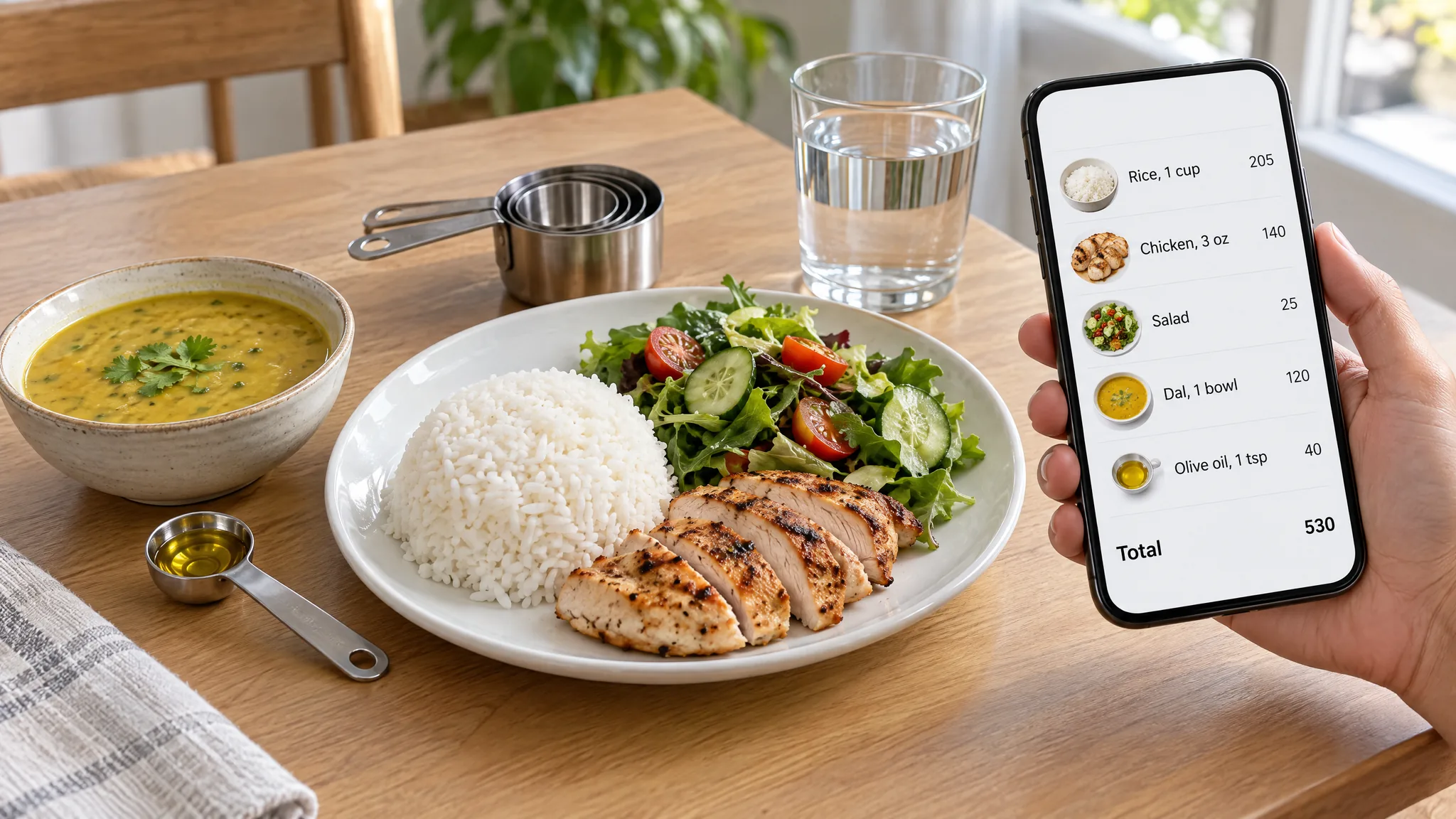
How to track calories without a food scale: the accuracy ladder
How accurate is calorie counting without a scale? It depends on the method. Studies of portion estimates and measuring tools point to roughly this order, though it varies by food:
| Method | Use it for | Evidence |
|---|---|---|
| Labels, menus, counted pieces | Packs, chains, eggs, slices, fruit | Bread slices and rolls described in words: 95% within 10% |
| Measuring cups and spoons | Rice, cereal, lentils, milk | A level, spooned cup is consistent; cups judged by eye are rough |
| Your own measured bowl or mug | Meals you repeat | No direct study; as close as your one-off measurement |
| Hand and object sizes | Eating out, food you can't measure | Close on average, rough for one meal |
| Eyeballing | Avoid it | Unaided photo estimates were off by 79% on average |
1. Start with labels and pack weights
A nutrition label is your most accurate entry, as long as you scale it to what you ate.
- US labels give a serving in cups or pieces, then grams. The FDA says it reflects what people typically eat, not a recommendation, so if you eat ¾ cup of a cereal labelled ½ cup, log ¾ cup.
- UK and EU labels must give energy per 100 g or 100 ml: a 45 g (1.6 oz) bowl of cereal at 370 kcal per 100 g is 167 kcal.
- Use the pack weight. A 500 g (17.6 oz) tub of yoghurt split into four similar bowls is about 125 g (4.4 oz) each.
Check the serving rather than assume it: when the consumer group Which? asked 122 volunteers to pour their usual bowl of cereal, they poured 63% more than the pack's suggested portion on average.
Labels are close, not exact. In the US, a food is misbranded if its calories exceed the label by more than 20%: a limit on understating, not a margin either way.
2. Count pieces wherever you can
Counting is one of the most reliable things you can do without a scale. In a Dutch study of 40 adults, bread slices and rolls described in words had a median error of 0%, with 95% of reports within 10% of the true amount. Shapeless foods such as scrambled egg and yoghurt managed only 12% within 10%.
Count eggs, slices, fruit, biscuits, rotis, even almonds (23 make an ounce, 28 g, at 164 kcal). Then add the size, because it moves the number:
| Food | Smaller | Larger |
|---|---|---|
| Egg | 63 kcal (medium) | 80 kcal (extra large) |
| Banana | 90 kcal (small) | 121 kcal (large) |
| Bread | 53 kcal (thin slice) | About 80 kcal (large slice) |
Rotis vary most: USDA's two commercial chapatis weigh 43 g and 68 g, and homemade ones differ again, so weigh one of yours once if you can, or log it as small, medium or large.
3. Measure food without a scale: cups and spoons, levelled
Cups and spoons suit foods you pour or scoop: rice, cereal, oats, lentils, milk and spreads. Filled the same way, they're consistent: in USDA tests, a spooned and levelled cup of flour averaged 126 g, and most came within 3 g of that. For chicken, steak or fish, use the pack weight or count pieces instead.
Sizes differ between countries and guides:
| Measure | Size |
|---|---|
| US label teaspoon, tablespoon, cup | 5 ml, 15 ml, 240 ml |
| British Nutrition Foundation portion guide | "Tablespoon" means a 10 ml eating spoon |
| ICMR-NIN standard katoris (India) | 115, 155, 200 and 360 ml |
| ICMR-NIN diet-chart cup or katori | 200 ml |
Cutlery isn't a measure: spoons from 25 Greek households held anywhere from 2.5 to 7.3 ml. Use measuring spoons for oil, ghee, sugar and nut butter.
How you fill the cup matters too:
| 1 cup of | Scooped or packed | Spooned in or loose |
|---|---|---|
| All-purpose (plain) flour | 143 g | 126 g |
| Brown sugar | 220 g (836 kcal) | 145 g (551 kcal) |
| Cooked spaghetti | 151 g (239 kcal) | 124 g (196 kcal) |
Spoon food in, level it with a knife and don't press it down. Measure in the state you'll log it: rice and pasta absorb water as they cook, so a cooked portion weighs more than the dry one (counting calories in homemade food covers raw and cooked weights).
4. Measure your own bowls, mugs and katoris once
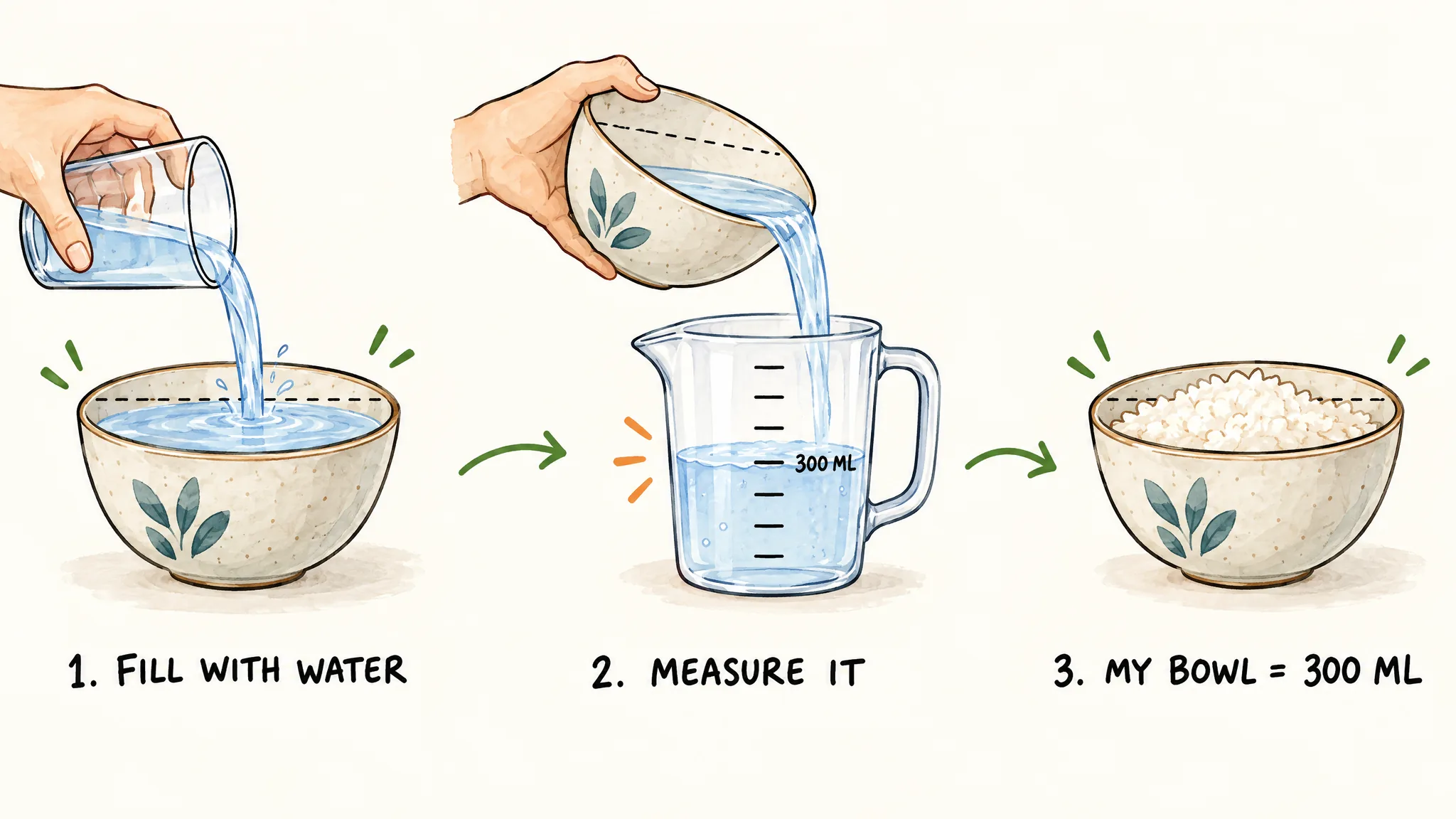
If you eat from the same few bowls, mugs and glasses, measure them once and log what they hold from then on:
- Find the volume. Fill your usual bowl with water to where you normally fill it with food, then pour the water into a measuring jug. No jug? If your bowl takes about half of a 500 ml (about 17 fl oz) bottle, it holds about 250 ml (about 1 cup).
- Turn volume into food. A 300 ml bowl is about 1¼ US cups, so filled level with cooked white rice it holds roughly 200 g (7 oz), about 260 kcal. A 200 ml katori (a little under a US cup) holds roughly 130 to 135 g (4.6 to 4.8 oz), about 170 kcal.
- Weigh once if you get the chance. An NHS leaflet on carb counting suggests weighing the foods you eat often once and recording the amounts.
In VitalityApp, log what the bowl holds ("200 g rice"), since typing "my bowl" only gets a typical bowl, and tick Save as a meal to re-log it later.
Every month or so, re-check how full you're filling it. In a review of 13 studies, portion-size training helped in the short term, but no study followed people beyond four weeks, some gains had faded by then, and the authors said training needs repeating.
5. Estimate portion sizes without a scale: hands and objects
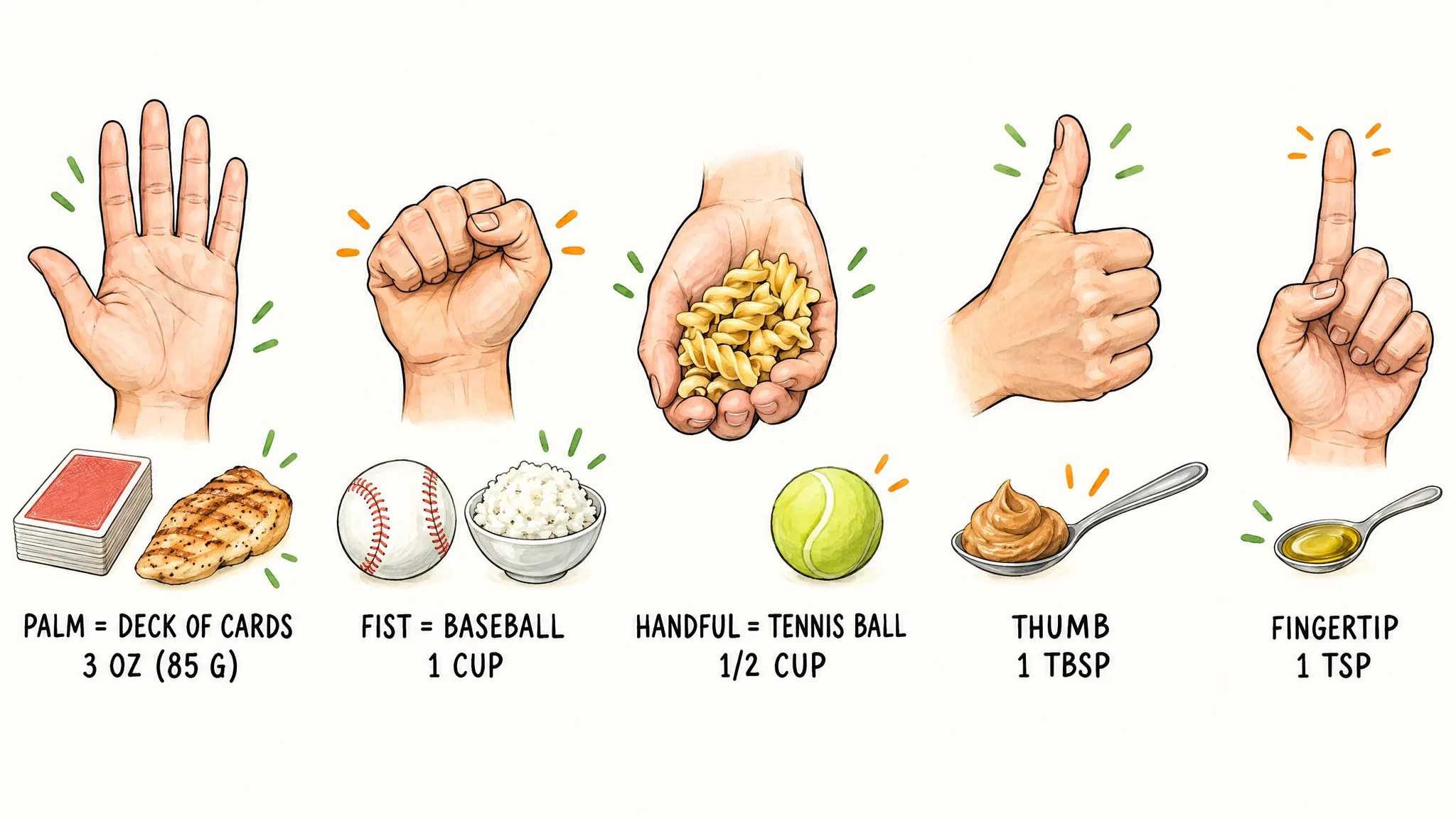
Hands go everywhere with you, which makes them useful when eating out. Two guides, from the Academy of Nutrition and Dietetics (US) and the British Nutrition Foundation (UK, 2019), give these sizes:
| Hand or object | About | Guide |
|---|---|---|
| Fist or baseball | 1 cup (240 ml) | US |
| Scooped handful or tennis ball | ½ cup (120 ml) of cooked rice, pasta or porridge | US |
| Palm or deck of cards | 3 oz (85 g) cooked meat or fish | US |
| Thumb | 1 tbsp (15 ml) of nut butter | US |
| Fingertip to first joint | 1 tsp (5 ml) of oil or fat | US |
| Two cupped hands | 180 g (6.3 oz) cooked rice or pasta | UK |
| Half your hand | 120 g (4.2 oz) grilled chicken breast | UK |
| Two thumbs together | 30 g (1 oz) cheddar | UK |
The guides define a portion differently (85 g of meat in one, 120 g of chicken in the other), and hands vary, so check your fist against a measuring cup once. Food and nutrition basics has a simple hand guide for building a meal.
How accurate are hand portions?
Rough. In a 2016 study of 67 adults, measuring regularly shaped foods such as pizza and cake in finger widths, then using formulas, got 19 of 24 items within 25% of the true weight but only 3 within 10%; judging them in cups by eye got 7 within 25%. Both methods overestimated chicken breast, steak and fish fillet by more than 50%. The fist did no better with rice, mashed potato, cereal and muffins: 6 of 8 portions were off by more than 50%.
A 2025 study of 12,148 meals eaten by 1,081 Japanese adults found hand counts close on average but often well off for a single meal, and least reliable for grains. The authors still judged the hand scale an appropriate tool.
Judging by eye is hard even for experts: with a size-reference card in every photo, fewer than a third of nutrition professionals estimated a meal's weight to within 10%.
How many grams in a cup? Common foods by cup, spoon and piece
Figures from USDA FoodData Central (SR Legacy), rounded, with metric and US weights side by side:
| Food | Measure | Weight | kcal (protein) |
|---|---|---|---|
| White rice, cooked | 1 cup | 158 g (5.6 oz) | 205 (4.3 g) |
| Rolled oats, dry | ½ cup | 41 g (1.4 oz) | 153 (5.3 g) |
| Lentils, boiled | 1 cup | 198 g (7.0 oz) | 230 (17.9 g) |
| White bread | 1 slice | 29 g (1.0 oz) | 77 (2.6 g) |
| Chapati, whole wheat, commercial | 1 piece | 43 g (1.5 oz) | 129 (3.4 g) |
| Chapati, plain, commercial | 1 piece | 68 g (2.4 oz) | 202 (7.7 g) |
| Egg, large | 1 | 50 g (1.8 oz) | 72 (6.3 g) |
| Chicken breast, roasted, no skin | 3 oz | 85 g | 140 (26.4 g) |
| Whole milk | 1 cup | 244 g (8.6 oz) | 149 (7.7 g) |
| Banana, medium | 1 | 118 g (4.2 oz) | 105 (1.3 g) |
| Apple, medium | 1 | 182 g (6.4 oz) | 95 (0.5 g) |
| Avocado | ½ | 100 g (3.5 oz) | 161 (2.0 g) |
| Almonds | 23 nuts | 28 g (1 oz) | 164 (6.0 g) |
| Peanut butter | 1 tbsp | 16 g (0.6 oz) | 96 (3.6 g) |
To measure 100 g without a scale, divide by the cup weight: 100 g of cooked white rice is just under ⅔ cup, and 100 g of boiled lentils about ½ cup.
The avocado row averages all varieties; half a California (Hass-type) avocado is 68 g and 114 kcal. Other databases differ slightly, so treat these as good estimates, not exact figures.
The hidden-calorie traps: oil, butter, dressings and drinks
Fats and drinks are easy to leave out, and easy to misjudge even when you remember them: in the Dutch study, jam and margarine described in words were underestimated by a median of 23%.
| Item | Amount | kcal |
|---|---|---|
| Olive oil | 1 tbsp (13.5 g) | 119 |
| Ghee (USDA butter oil) | 1 tbsp (12.8 g) | 112 |
| Butter | 1 tbsp (14.2 g) | 102 |
| Mayonnaise | 1 tbsp (13.8 g) | 94 |
| Ranch dressing | 2 tbsp (30 g) | 129 |
| Orange juice | 1 cup (240 ml) | 112 |
| Cola | 12 fl oz (355 ml) | 155 |
| Cola, large fountain drink | 32 fl oz (about 950 ml) | 413 |
| Beer, regular | 12 fl oz (355 ml) | 153 |
| Red wine | 5 fl oz (about 150 ml) | 125 |
Three habits help:
- Measure the fat, not the food. Pour oil into a measuring spoon, not straight from the bottle, and split it between the people eating: two tablespoons of olive oil in a curry for four is about 60 kcal each. For a whole pot, work it out from the ingredients.
- Get dressings and sauces on the side, and log the spoonfuls you use.
- Log drinks as their own line, including the milk and sugar in tea and coffee.
Eating out: use the published number
Restaurant meals are easy to misjudge. In a 2013 BMJ study at US fast food chains, adults underestimated their meal by 175 kcal on average, about a quarter of all diners underestimated by 500 kcal or more, and bigger meals had bigger misses.
Use the restaurant's own figure when there is one. Many must publish it:
| Where | Who must show calories | Since |
|---|---|---|
| US | Chains with 20 or more locations | 7 May 2018 |
| England | Businesses with 250 or more employees, also on delivery apps | 6 April 2022 |
| India | Outlets with a central licence, or with 10 or more locations | 2022 |
These figures are good, not perfect. In US restaurant foods tested in 2010, stated calories were right on average, but 19% of 269 items had at least 100 kcal more than stated. In England, a 2025 study of 295 calorie-labelled menu items, tested after the law came in, found the menu figure more than 20% off the lab-measured value for 35% of items, more often too high (23%) than too low (11%). India's food regulator accepts a 25% deviation in menu calories.
No figure on the menu? Borrow one. In a 2016 study, frequently ordered meals at US non-chain restaurants averaged 1,205 kcal, not significantly different from equivalent chain meals, so a chain's figure for a similar dish is a reasonable starting point. Those meals ran large (92% had more energy than people typically need at one meal), so if you're torn between two sizes, log the larger. For a mixed plate, log each part separately, including the oil or butter it's likely cooked in.
Stay consistent, then check your log against your weight
For most goals, consistency beats precision. A review of 22 studies found a consistent link between self-monitoring, such as a food diary, and weight loss, though the evidence was weak.
Small, steady gaps add up. A rule of thumb from a 2011 Lancet paper is that, for an average overweight adult, each lasting change of 10 kcal a day eventually shifts weight by about 1 lb (0.45 kg), half of it within about a year. So if your log misses a tablespoon of oil a day (about 120 kcal), you can settle about 5 kg (11 to 12 lb) heavier than your logged intake suggests.
Close the loop:
- Log everything for two to three weeks, the same way each day, including oil and drinks.
- Compare weekly average weights, not single days. Why the scale went up when you ate well shows how to read the trend.
- If your log says you're eating less than you need but the trend hasn't moved, something is probably missing or your portions are bigger than you're logging. Re-measure your bowls, add the fats and drinks you skipped, and check again in two weeks.
When a food scale is worth buying
A basic digital kitchen scale earns its place if:
- You count carbs for insulin. In a study of 50 adults with type 1 diabetes, meal carb estimates were off by 15.4 g (about 21%) on average, and bigger errors went with more variable blood glucose. An NHS hospital leaflet calls digital kitchen scales "a useful addition to your diabetes 'tool box'". Follow your diabetes team's advice.
- You bake. A cup of flour can weigh 116 g sifted or 143 g scooped, a 23% difference.
- Your log and your weight disagree for a month. A week of weighing your usual portions shows which ones you've misjudged.
- You have precise targets, such as a sport with weigh-ins, or numbers a doctor or dietitian has set.
Tracking isn't right for everyone. In a study of 493 college students, those using calorie trackers reported more eating concern and dietary restraint. That kind of study can't show cause and effect, but if you have a history of disordered eating, are pregnant, or manage a medical condition through diet, talk to a doctor or registered dietitian before counting calories. VitalityApp's figures are general wellness information, not medical advice: see the medical disclaimer.
Logging rough portions in one line with VitalityApp
VitalityApp doesn't weigh food or connect to a kitchen scale. You describe what you ate with the portions you know:
- Type it in one line. On Home, tap Log a Meal on the Meals card (Log Meal once the day has food) and type under What did you eat?, for example "2 roti, 1 katori dal, 1 tsp ghee and 1 cup rice".
- Tap Find nutrition. VitalityApp turns counts, cups, katoris, spoons and sizes into an AI estimate of grams for each food. Grams you type are used as they are.
- Check your meal. Tap a food to change Quantity (grams) or pick a serving size, choose the meal under Which meal is this? and add the foods.
- Save your repeats. Tick Save as a meal before adding. Next time, tap + next to a meal on the Meals tab, pick it under My Saved Meals, adjust any ingredient's grams and tap Add to ….
- Or say it. On the Meals tab, tap + next to a meal, then the microphone at the top right, next to the camera icon (where your device supports speech input).
You can't type calories from a label or menu by hand. Instead, type the brand or restaurant and the item with the amount, and the AI can look it up, or scan the label into a saved meal: on the Meals tab, tap + next to a meal, then Can't find your food? Create a custom meal, then Scan label.
Typing and voice logging are free on every plan, with a fair-use limit of 50 AI food searches a day. Weight tracking and Trends are free too. Food amounts are shown and adjusted in grams (1 oz is 28 g), while body weight can be in kg or lbs. Photo, barcode and label scans are 2 a month in total on the free plan and up to 50 a day on Plus, and barcode scanning works in the iPhone and Android apps only.
Frequently asked questions
Can you count calories accurately without weighing food? Accurately enough for most goals. Labels and counted pieces are close; cups and hand sizes are rough for one meal but closer on average, and your weight trend shows up any steady error.
Do I need a food scale to lose weight? Not usually. Logging the same way every day and checking your log against your weekly weight trend matter more. A scale helps most if you count carbs for insulin, bake or have precise targets.
How do I measure food without a scale or measuring cups? Use pack weights and count pieces. Measure your usual bowl once with a jug or a bottle of known size. Use your hand for the rest: a fist is about a cup (240 ml), and a palm about 3 oz (85 g) of cooked meat.
How much rice is one portion without a scale? A level US cup of cooked white rice is 158 g and 205 kcal. The British Nutrition Foundation's portion is what fits in two cupped hands, about 180 g.
Can a photo app estimate portions instead of a scale? It can help, but a camera can't see hidden oil or how deep a bowl is. In a 2026 study of Central Asian dishes, an AI model was off by 68% on average: closer than people guessing unaided (79%), but not as close as people using a food atlas (45%). How accurate is AI photo calorie counting? covers when a photo helps.
Keep reading
- How to count calories in homemade food and recipes: working out a home-cooked dish from its ingredients.
- Is MyFitnessPal free in 2026?: what the free plan includes, and free alternatives.
- Why the scale went up when you ate well: reading your weekly weight trend.
- How accurate is AI photo calorie counting?: where photo estimates hold up and where they miss.
- How to count calories in Indian food: portions, katoris, oil and ghee in Indian meals.
- AI calorie counter: logging by typing, voice, photo, barcode and label in VitalityApp.
Sources
All checked on 14 October 2026.
- Gibson AA, Hsu MSH, Rangan AM, et al. Accuracy of hands v. household measures as portion size estimation aids. Journal of Nutritional Science, 2016;5:e29.
- Shinozaki N, Murakami K, Masayasu S, Sasaki S. Is the hand scale an appropriate tool for guiding and estimating food portions? An evaluation among free-living adults. Appetite, 2025;215:108232.
- Lucassen DA, Willemsen RF, Geelen A, Brouwer-Brolsma EM, Feskens EJM. The accuracy of portion size estimation using food images and textual descriptions of portion sizes: an evaluation study. Journal of Human Nutrition and Dietetics, 2021;34(6):945-952.
- Hooper A, McMahon A, Probst Y. The role of various forms of training on improved accuracy of food-portion estimation skills: a systematic review of the literature. Advances in Nutrition, 2019;10(1):43-50.
- Fatehah AA, Poh BK, Shanita SN, Wong JE. Feasibility of reviewing digital food images for dietary assessment among nutrition professionals. Nutrients, 2018;10(8):984.
- Nurmanova B, Omarova Z, Sanatbyek A, Varol HA, Chan MY. Evaluating a multitask artificial intelligence model compared with humans for portion-size estimation. Journal of Nutrition, 2026;156(8):101658.
- Falagas ME, Vouloumanou EK, Plessa E, Peppas G, Rafailidis PI. Inaccuracies in dosing drugs with teaspoons and tablespoons. International Journal of Clinical Practice, 2010;64(9):1185-1189.
- Block JP, Condon SK, Kleinman K, et al. Consumers' estimation of calorie content at fast food restaurants: cross sectional observational study. BMJ, 2013;346:f2907.
- Urban LE, McCrory MA, Dallal GE, et al. Accuracy of stated energy contents of restaurant foods. JAMA, 2011;306(3):287-293.
- Finlay A, Jones A, Thorp P, et al. Accuracy of menu calorie labelling in the England out-of-home food sector during 2024: assessment of a national food policy. British Journal of Nutrition, 2025;134(8):696-704.
- Urban LE, Weber JL, Heyman MB, et al. Energy contents of frequently ordered restaurant meals and comparison with human energy requirements and U.S. Department of Agriculture database information: a multisite randomized study. Journal of the Academy of Nutrition and Dietetics, 2016;116(4):590-598.e6.
- Burke LE, Wang J, Sevick MA. Self-monitoring in weight loss: a systematic review of the literature. Journal of the American Dietetic Association, 2011;111(1):92-102.
- Hall KD, Sacks G, Chandramohan D, et al. Quantification of the effect of energy imbalance on bodyweight. The Lancet, 2011;378(9793):826-837.
- Brazeau AS, Mircescu H, Desjardins K, et al. Carbohydrate counting accuracy and blood glucose variability in adults with type 1 diabetes. Diabetes Research and Clinical Practice, 2013;99(1):19-23.
- Simpson CC, Mazzeo SE. Calorie counting and fitness tracking technology: associations with eating disorder symptomatology. Eating Behaviors, 2017;26:89-92.
- US Food and Drug Administration. How to understand and use the Nutrition Facts label.
- US Food and Drug Administration. Menu labeling requirements.
- 21 CFR 101.9: Nutrition labeling of food. US Code of Federal Regulations, via Cornell Legal Information Institute.
- Regulation (EU) No 1169/2011 on the provision of food information to consumers, Article 32, as retained in UK law. legislation.gov.uk.
- Department of Health and Social Care. Calorie labelling in the out of home sector: implementation guidance. GOV.UK, 2021.
- Food Safety and Standards Authority of India. Guidance note on menu labelling (PDF). February 2022.
- ICMR-National Institute of Nutrition. Dietary Guidelines for Indians (PDF), Annexure I. 2024.
- Academy of Nutrition and Dietetics. Serving size vs. portion size: is there a difference? eatright.org, published 18 December 2018, reviewed 2 February 2026.
- British Nutrition Foundation. Find your balance: an easy guide for finding the right balance for you (PDF). January 2019.
- Sherwood Forest Hospitals NHS Foundation Trust. A guide to carbohydrate counting (patient leaflet, PDF). April 2026.
- Which?. Are you eating too much breakfast cereal? 30 September 2020.
- Fulton L, Matthews E, Davis C. Average weight of a measured cup of various foods. USDA Home Economics Research Report No. 41, 1977.
- US Department of Agriculture, Agricultural Research Service. FoodData Central, SR Legacy (April 2018). FDC IDs: 168878 (rice), 169737 (pasta), 173904 (oats), 172421 (lentils), 174924 (white bread), 174075 and 171844 (chapati), 171287 (egg), 171477 (chicken), 171265 (milk), 173944 (banana), 171688 (apple), 171705 and 171706 (avocado), 170567 (almonds), 172470 (peanut butter), 171413 (olive oil), 173410 (butter), 173412 (butter oil), 171009 (mayonnaise), 173592 (ranch dressing), 168833 (brown sugar), 169098 (orange juice), 174852 (cola), 168746 (beer), 173190 (red wine).