Why the Scale Went Up When You Ate Well: Read Weekly Trends, Not Daily Weigh-ins
11 min read
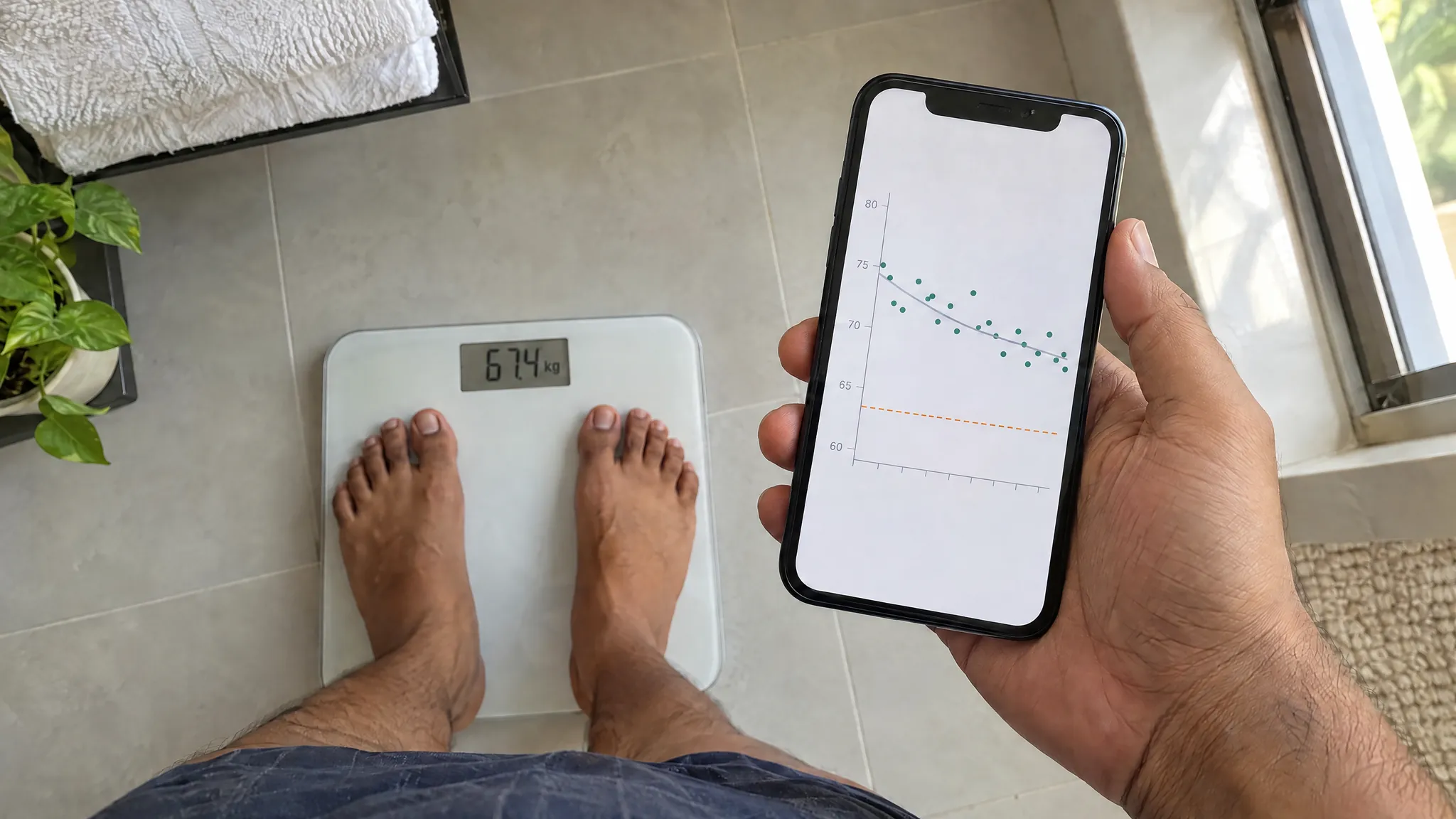
You had a good day. Oats for breakfast, a big salad with chicken and beans for lunch, a walk in the evening, an early dinner, and your calories right on target. The next morning you step on the scale and it says you're 0.8 kg heavier than yesterday.
It's tempting to decide the plan isn't working. It almost certainly is. A single weigh-in mostly measures water, food and timing, not fat. Your weight can move by most of a kilo from one morning to the next for reasons that have nothing to do with fat. What tells you whether you're losing, gaining or holding steady is the trend over one to three weeks.
This post covers why one day's jump can't be fat, what really moves the scale overnight, the weekly rhythm most people have, and how to read your trend, with how each step works in VitalityApp.
Why one day's jump can't be fat
To put on a kilo of body fat, you'd have to eat roughly 7,700 calories more than you burn. That's where the old rule of thumb of 3,500 calories per pound comes from. Research shows the real figure behind a kilo of weight change varies from person to person, because the weight you gain or lose is never pure fat, but it's thousands of calories either way.
A day of sensible meals at your calorie target doesn't come close. Even a big celebration dinner that puts you 1,000 calories over could only add about 130 g of fat. So when the scale jumps by most of a kilo overnight, nearly all of it is something else.
And jumps like that are normal. In a classic 1964 study, researchers weighed 19 people, from babies to middle-aged adults, every day for several weeks while they went about their ordinary lives. A day's reading typically sat about 0.5% of body weight above or below that person's underlying trend, and the change from one morning to the next rarely went beyond 1.5%. For someone who weighs 70 kg, that's a typical wobble of about 0.35 kg either side of the trend, and the occasional overnight jump of up to a kilo, with no change in body fat at all.
What actually moves the scale overnight
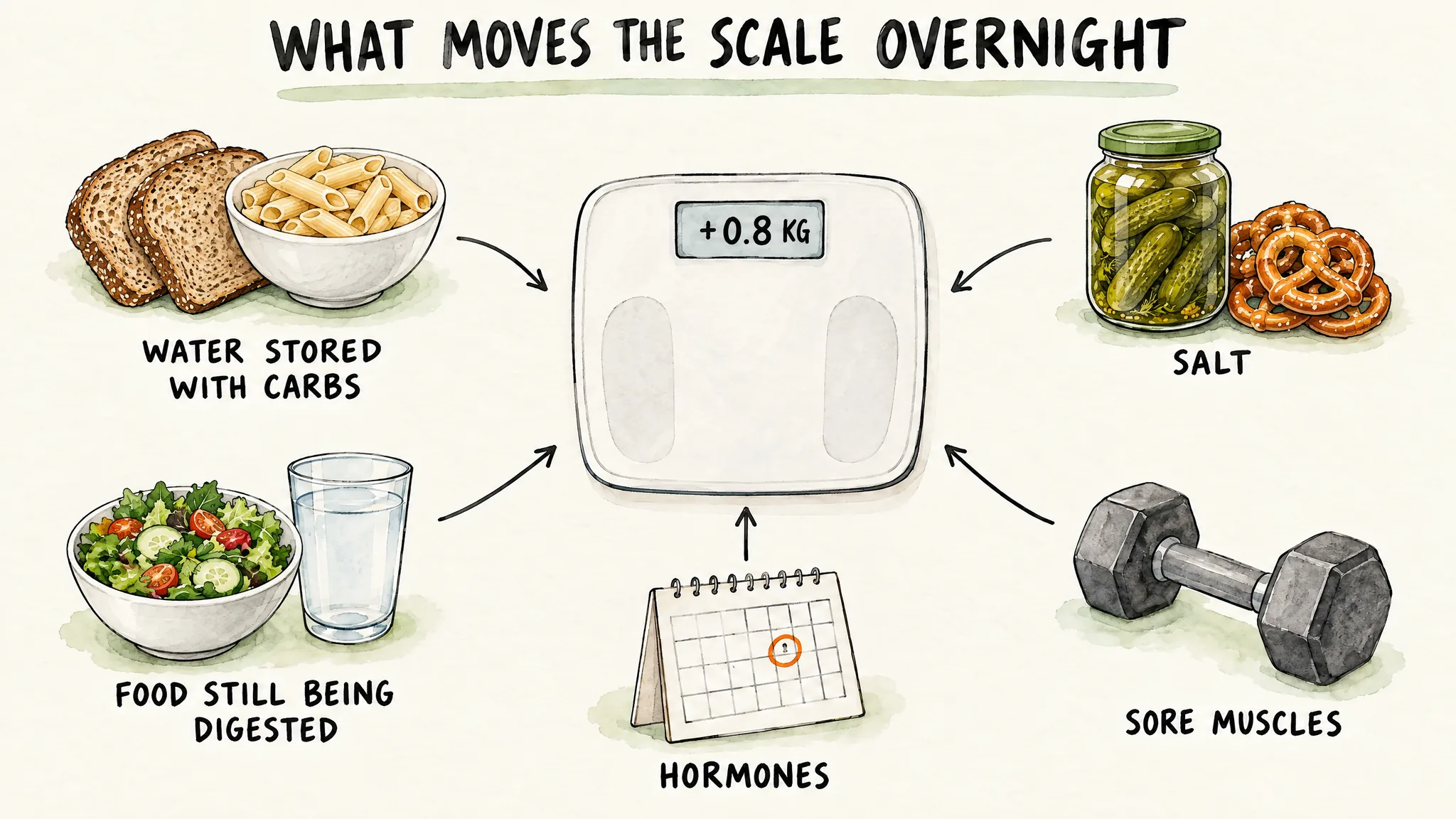
1. Water stored with carbohydrate
Your muscles and liver keep a reserve of carbohydrate called glycogen: about 600 g in total for an adult, though it varies a lot with body size, diet and exercise. Each gram of glycogen is stored with at least 3 g of water.
So when your glycogen tops up, the water comes with it. Topping up just a quarter of that store, about 150 g of glycogen, adds about 600 g on the scale once you count its water. That happens when you eat more bread, pasta, rice, potatoes or fruit than the day before, or after a few days of eating lightly.
It works the other way too. It's why the first week of a new diet often shows a big drop that then slows down: much of the early loss is glycogen and water, not fat.
2. Salt
A salty meal can make your body hold on to extra water for a day or so. Restaurant and takeaway meals, cheese, cured meats, pickles, salty snacks and instant noodles are the usual sources. How much it shows varies from person to person, and it passes on its own once you're back to your usual meals.
3. Food and drink still in your body
Food and water weigh something until you've digested and passed them. A litre of water weighs a kilo, and a plate of pasta with sauce and a side salad can easily weigh half a kilo. Weigh yourself before and after a trip to the toilet and you'll see the difference.
Eating well can make this bigger, not smaller. Vegetables, beans, lentils, salad, fruit and whole grains are bulky and high in fibre, which holds water in the gut. A day of eating well can weigh more the next morning than a day of pastries and coffee, even with fewer calories.
4. Hormones and the menstrual cycle
Many women hold more water at certain points in their cycle. In a year-long study of 62 women across 765 cycles, the fluid retention they reported peaked on the first day of their period and was lowest about a week later.
So the scale can read higher around your period without any change in fat. Compare a weigh-in with the same point in your last cycle, not with last week.
5. A new or harder workout
After a tough or unfamiliar workout, sore muscles hold on to some extra water while they repair, and muscles you train regularly store more glycogen, with its water. Both can nudge the scale up for a few days even as you get fitter. A long, sweaty session does the opposite: the scale drops, but that's water you'll drink back.
6. When and how you weigh
An evening weigh-in, after a day of eating and drinking, will read higher than the morning one. Clothes, a full bladder, a glass of water before you step on, or a scale moved onto a rug or uneven floor can all change the number too.
The weekly rhythm: up at the weekend, down by Friday
Most people's weight also follows a weekly pattern. A 2014 study that tracked the weight of 80 adults found their weight was highest on Sunday and Monday, fell from Tuesday through the week, and rose again from Saturday. A larger 2020 study of 1,421 adults in a European weight-maintenance programme, who weighed themselves on smart scales, found the same shape: highest on Monday, lowest on Friday, with a swing of about 0.35% of body weight within the week.
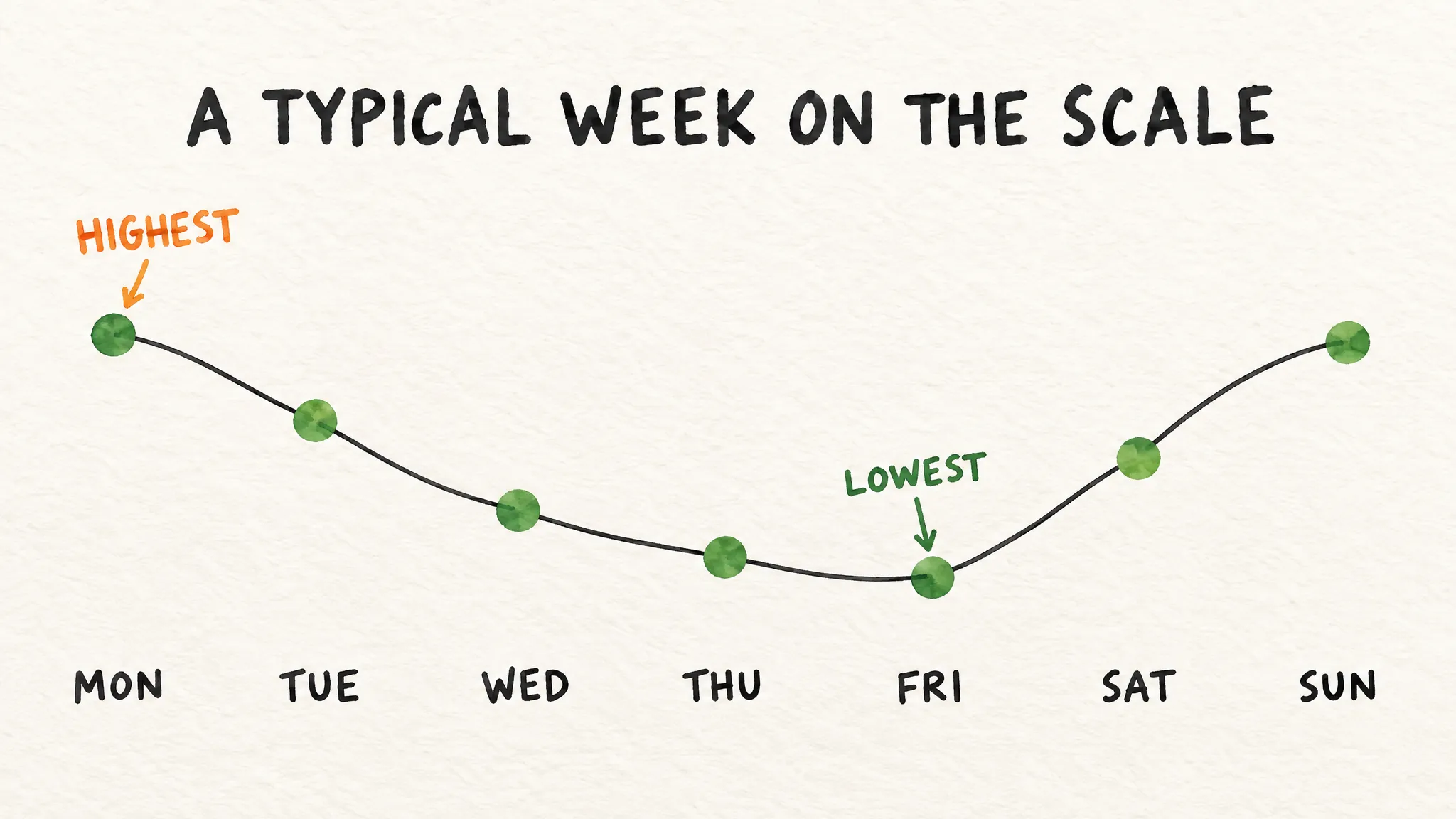
In the 2014 study, the people who lost weight or kept it off still had weekend bumps. What set them apart was that their weight came back down during the week. The people slowly gaining weight had the weakest weekday drop.
Two things follow from this:
- Compare like with like. Compare Monday with last Monday, or this week's average with last week's. Monday against Friday will often look like a gain.
- Watch for the bump that stays. A weekend bump that's gone by Thursday is normal. In the 2020 study, weight rose by about 1.35% over Christmas, and it wasn't fully lost in the months that followed. With the end-of-year holidays coming up, that's the kind of change your trend will show you and a single Monday reading won't.
Read the week, not the day
Here's what two weeks of morning weigh-ins can look like for someone who is slowly losing weight. These are example numbers:
| Day | Week 1 (kg) | Week 2 (kg) |
|---|---|---|
| Monday | 72.8 | 73.1 |
| Tuesday | 72.5 | 72.6 |
| Wednesday | 72.6 | 72.2 |
| Thursday | 72.2 | 72.0 |
| Friday | 72.1 | 71.8 |
| Saturday | 72.4 | 72.1 |
| Sunday | 72.9 | 72.4 |
| Average | 72.5 | 72.3 |
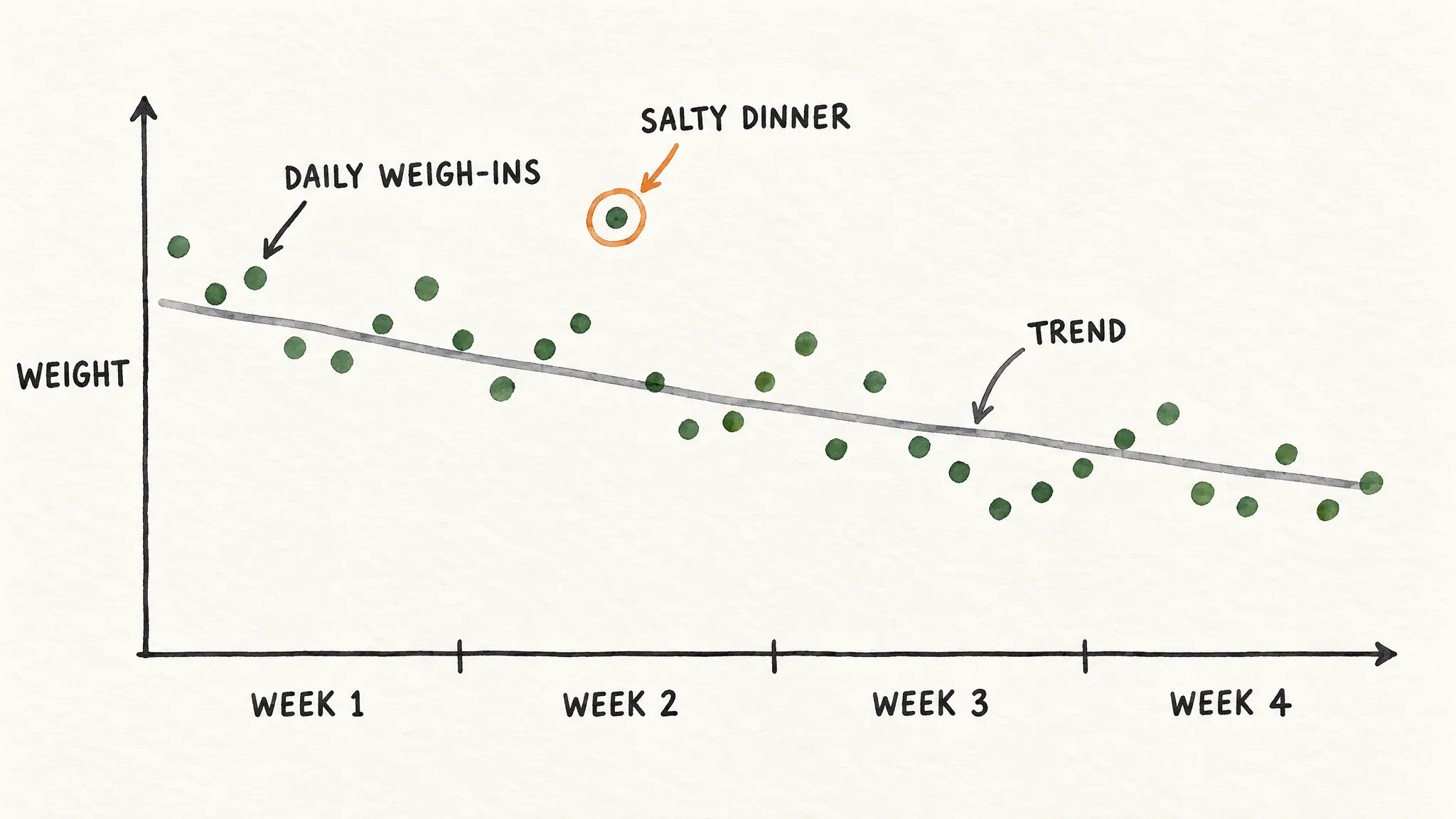
The highest reading of the fortnight came on the second Monday, after a weekend of eating out. Judged on that day alone, the week started badly. But the second week's average was 0.2 kg lower than the first. Over a few more weeks, that average is what tells you which way you're really heading.
A smoothed trend line does the same job without the arithmetic. One high day barely moves it, while a real change shows up within a week or two.
How to weigh yourself so the numbers mean something
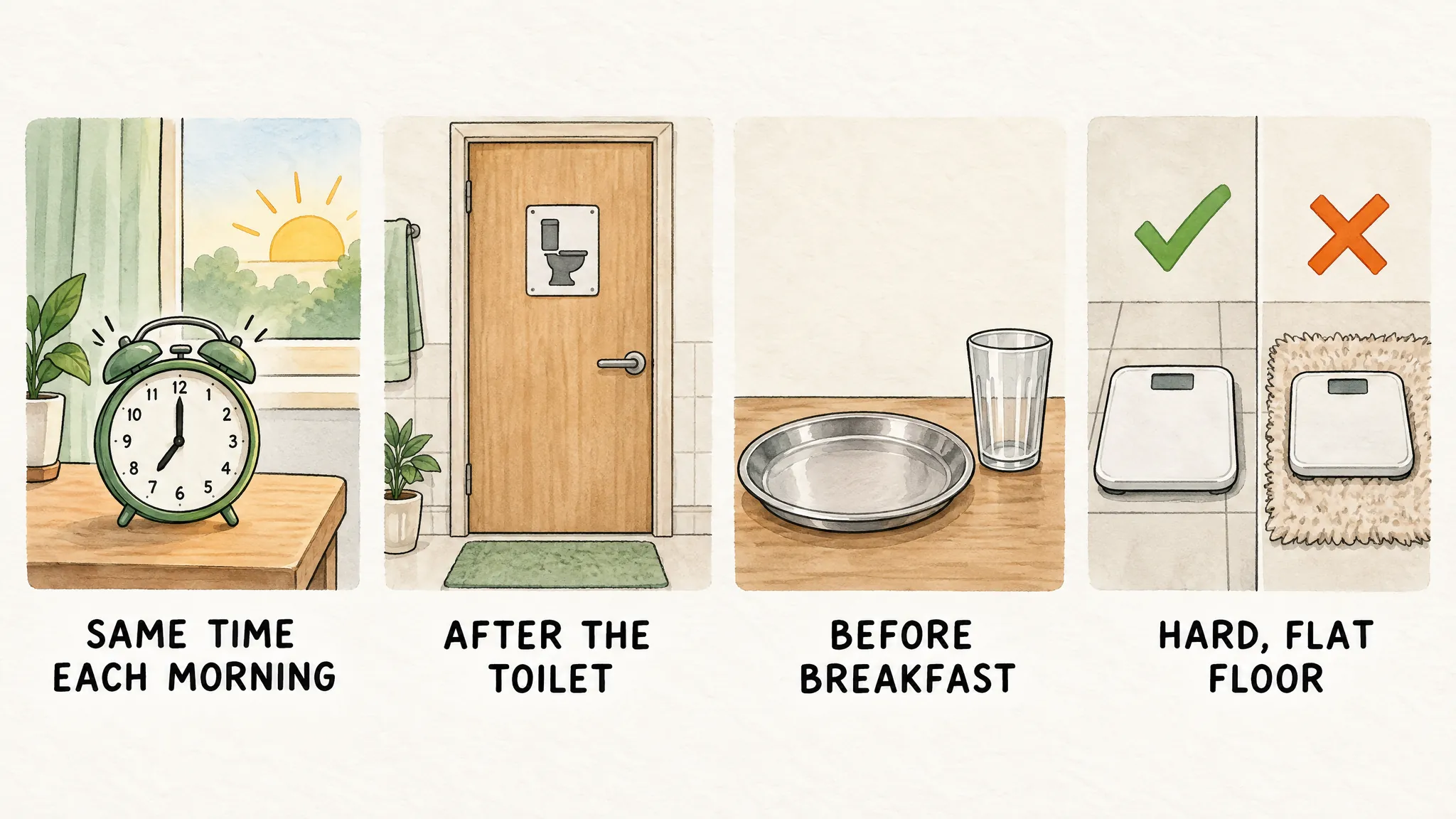
- Weigh the same way every time. First thing in the morning, after the toilet, before you eat or drink, in the same clothes, on the same scale on a hard, flat floor.
- Weigh often, and judge by averages. Weighing daily or on most days gives the average enough points to smooth out the noise. In one 6-month weight loss study, people who weighed every day lost about 6 kg more than those who weighed on most days, and took up more weight control habits. People weren't randomly split into daily and less frequent weighers, so the daily weighers may simply have been more engaged, but frequent weighing and steady progress went together.
- Give any change two to three weeks. If you're losing half a kilo a week, that's less than a normal day's swing, so it takes a couple of weeks of averages to see it clearly. Don't cut your calories because of one bad morning.
- Look past the scale. Your waist measurement, how your clothes fit, your energy and your strength all change with body fat, and none of them care how much salt was in last night's dinner.
- Weigh less often if daily numbers upset you. Once a week, on the same day and under the same conditions, still works, as long as you remember that any single reading can be off by most of a kilo. If weighing yourself leaves you anxious, or tempted to skip meals to move the number, take a break from the scale and talk to a doctor or someone you trust.
Seeing your trend in VitalityApp
VitalityApp keeps your weigh-ins and your meals in one place, so you can read them side by side.
Log a weigh-in. On Home, tap Metrics, then Quick weigh-in, enter your weight and tap Save Entry. A weight you log for today also becomes your profile's current weight. If you have a smart scale, connect Apple Health or Health Connect from Profile, and your weigh-ins come into VitalityApp, with body fat if your scale measures it, whenever you open the app.
See your trend. On Home, tap Metrics, then See your trend. Each weigh-in is a dot on the weight chart. Once you have at least three weigh-ins, mostly no more than two weeks apart, a grey Trend line appears. It uses the smoothing from John Walker's The Hacker's Diet: when you weigh in daily, each new reading pulls the line about a tenth of the way towards it. One salty dinner barely shifts it, and a real change shows up within a week or two.
A few more details on the chart:
- Gaps of more than two weeks between weigh-ins are drawn dashed, because nobody knows what happened in between.
- If you've set a target weight, it shows as a dashed line.
- 7D, 30D, 90D and All zoom in and out without changing the trend.
Check the week's eating. The Trends tab covers the 7 days ending on the day you pick, with cards for sleep, water, workouts and calories. The calories card shows your average against your target, with a bar for each day that's green when you were within 10% of your target, a line saying how many days met your goal, and your protein, carbs, fat and fibre for each day. Days you didn't log are left blank, not counted as zero. To see an earlier week, pick an earlier date at the top.
Put the two together. If your logged calories have been on target for two to three weeks and the Trend line still hasn't moved, one of two things is usually going on:
- Your log is missing something. Cooking oil, butter, sauces, drinks and weekend meals are the usual gaps. How accurate is AI photo calorie counting? covers where estimates miss and how to close the gap.
- Your target needs updating. As you lose weight, you need fewer calories. In Profile, tap Recalibrate to get a new plan from your current weight.
If the trend is moving at the pace you want, keep going, whatever this morning's number says.
When to talk to a doctor
Normal water swings come and go within days without visible swelling. See a doctor if your weight goes up quickly along with swelling in your ankles, feet, legs, tummy or face, if the swelling gets worse or doesn't settle in a few days, or if you have a heart or kidney condition. Get help urgently if the swelling comes with shortness of breath or a tight, heavy or painful chest. Fluid retention like this can be a sign of a heart, kidney or liver problem.
VitalityApp's figures are general wellness information, not medical advice: see the medical disclaimer.
Frequently asked questions
How much does weight normally go up and down in a day? In the 1964 study above, a day's reading typically sat about 0.5% of body weight above or below the trend, and the change from one morning to the next rarely went beyond 1.5%. For a 70 kg person, that's about 0.35 kg typically and up to about a kilo now and then. Weights taken at different times of day vary more, because of what you've eaten and drunk since the morning.
Should I weigh myself every day? If it doesn't stress you, yes. More weigh-ins make the average more reliable, and a trend line needs regular points. Just judge by the weekly average or the trend, never by a single day. If daily numbers get to you, a weekly weigh-in on the same day works too.
What's the best time to weigh myself? First thing in the morning, after the toilet and before you eat or drink, in the same clothes. Doing it the same way every time matters more than the exact time.
Why did I lose 2 kg in my first week and then hardly anything? Much of the first week's drop is glycogen and the water stored with it, which goes quickly when you eat less, especially fewer carbs. After that, the scale follows fat loss, which is slower. The slower part is the real progress.
I ate at my target all week and the scale went up. Should I eat less? Not yet. Compare this week's average with last week's, and give it two to three weeks. If the trend still hasn't moved, check your log for missing oil, drinks and weekend meals before you cut calories.
Keep reading
- How accurate is AI photo calorie counting?: where photo estimates hold up, where they miss, and how to get closer numbers.
- Food and nutrition basics: macros, portions and how to build a balanced plate.
- AI calorie counter: logging by typing, voice, photo, barcode and label in VitalityApp.
- Introducing VitalityApp: what the app does and who it's for.
Sources
All checked on 13 October 2026.
- Khosla T, Billewicz WZ. Measurement of change in body-weight. British Journal of Nutrition, 1964;18(2):227–239.
- Hall KD. What is the required energy deficit per unit weight loss? International Journal of Obesity, 2008;32(3):573–576.
- Murray B, Rosenbloom C. Fundamentals of glycogen metabolism for coaches and athletes. Nutrition Reviews, 2018;76(4):243–259.
- White CP, Hitchcock CL, Vigna YM, Prior JC. Fluid retention over the menstrual cycle: 1-year data from the Prospective Ovulation Cohort. Obstetrics and Gynecology International, 2011;2011:138451.
- Orsama AL, Mattila E, Ermes M, van Gils M, Wansink B, Korhonen I. Weight rhythms: weight increases during weekends and decreases during weekdays. Obesity Facts, 2014;7(1):36–47.
- Turicchi J, O'Driscoll R, Horgan G, et al. Weekly, seasonal and holiday body weight fluctuation patterns among individuals engaged in a European multi-centre behavioural weight loss maintenance intervention. PLoS ONE, 2020;15(4):e0232152.
- Steinberg DM, Bennett GG, Askew S, Tate DF. Weighing every day matters: daily weighing improves weight loss and adoption of weight control behaviors. Journal of the Academy of Nutrition and Dietetics, 2015;115(4):511–518.
- Walker J. The Hacker's Diet. Fourmilab.
- NHS. Swollen ankles, feet and legs (oedema).