Food Is Global. Nutrition Tracking Should Be Too.
11 min read
A plate of food carries more context than a calorie count. There's the name you grew up using, the way your family prepares it, and the portion you actually serve. When you track a meal, those details matter.
VitalityApp brings regional context and the details you add about your meal into photo-based nutrition tracking, helping you log the foods you eat across different cuisines. This post explains how that works, where it helps, where a photo still falls short, and how to get the most out of a scan.
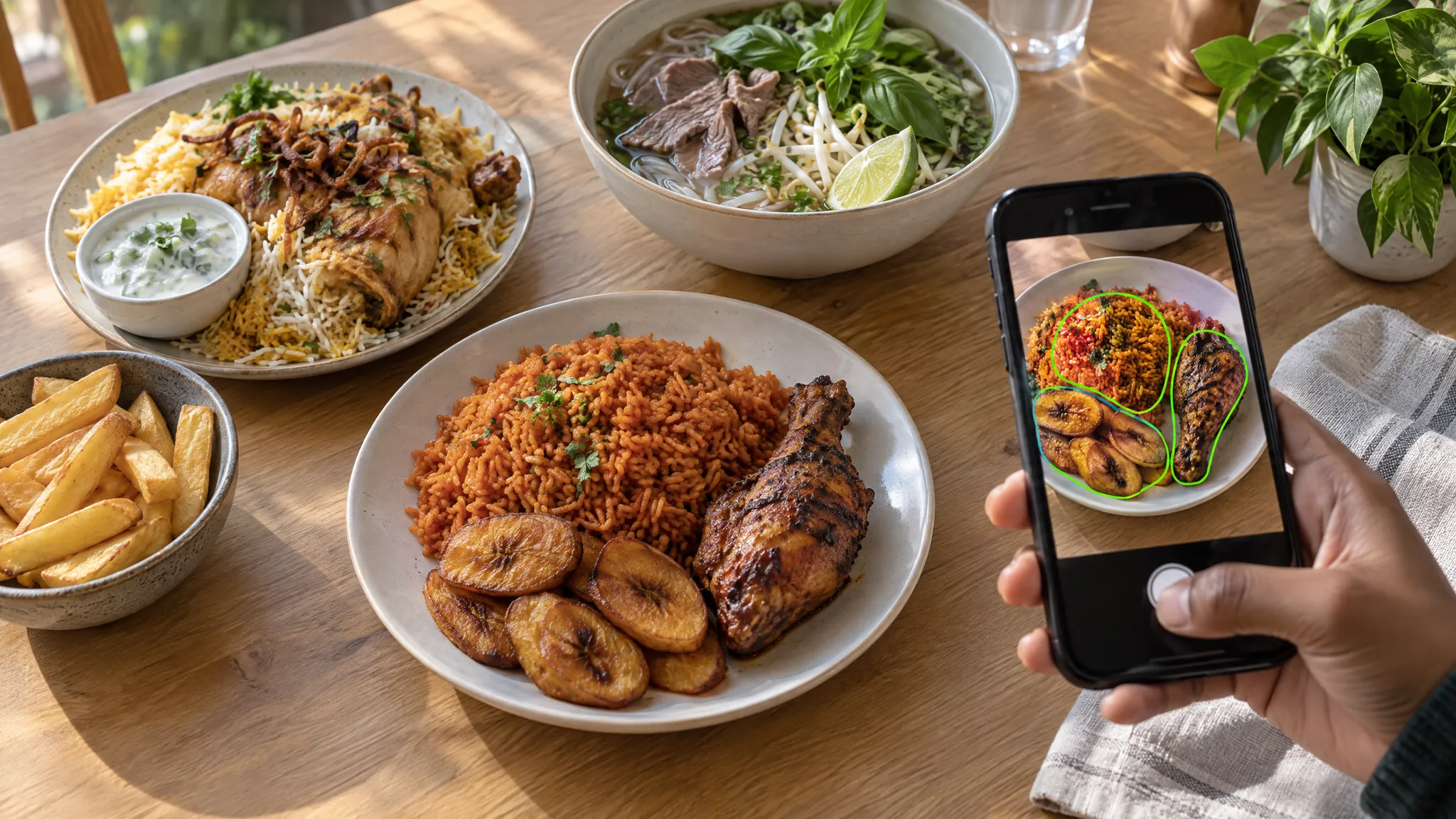
1. The same name can mean different foods
Ask for "chips" in the UK and you'll usually get something different from a bag of chips in the US. Familiar words can describe different foods, while similar dishes can have different names across regions.
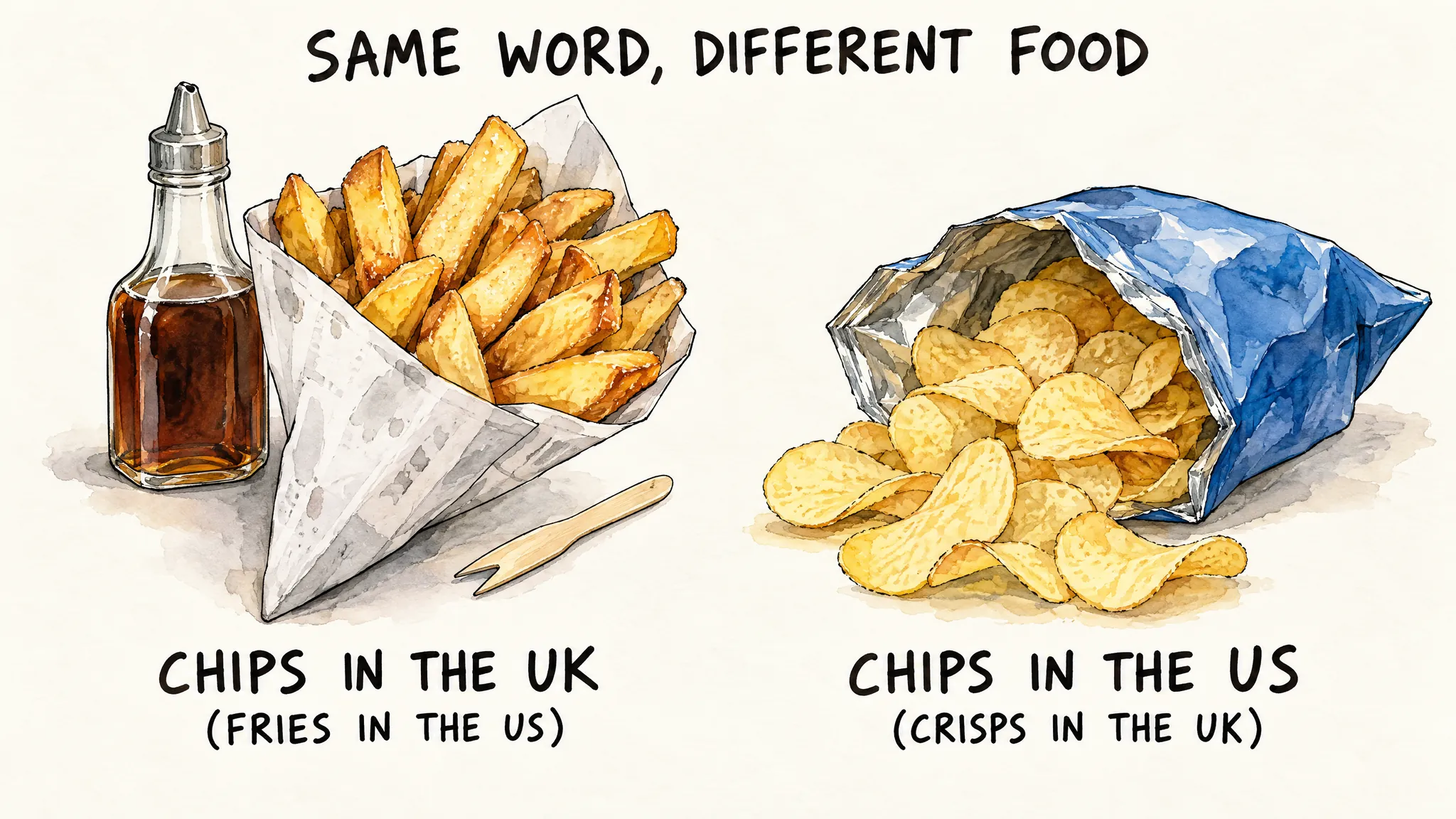
That difference shows up in the numbers. Gram for gram, crisps have far more calories than chip-shop chips, because they're sliced thin and fried until almost all the water is gone. Log one as the other and the entry is off by a wide margin.
Chips aren't the only word that changes meaning at a border:
- Biscuits: in the UK, a biscuit is what Americans call a cookie. In the US, it's a soft, scone-like bread, often served with gravy.
- Muffins: an English muffin is a flat, bready roll for toasting. An American muffin is closer to a small cake, with far more sugar and fat.
- Lemonade: in the UK, lemonade is usually a clear, fizzy soft drink. In the US, it's still, made from lemon juice, water and sugar.
- Jelly: in the UK, jelly is a wobbly gelatine dessert. In the US, it's a fruit spread for toast.
- Tea: in the UK, tea usually comes with milk. In Japan and China, it's usually drunk plain. In the American South, "tea" can mean sweet iced tea.
It works the other way round too: one food, many names. Aubergine and eggplant are the same vegetable. So are courgette and zucchini, coriander and cilantro, and spring onions and scallions. Prawns in one country are shrimp in another.
Same dish, different recipe
Recipes add another layer. Two dishes with the same name may use different ingredients, cooking methods and serving sizes. Those differences affect their nutrition.
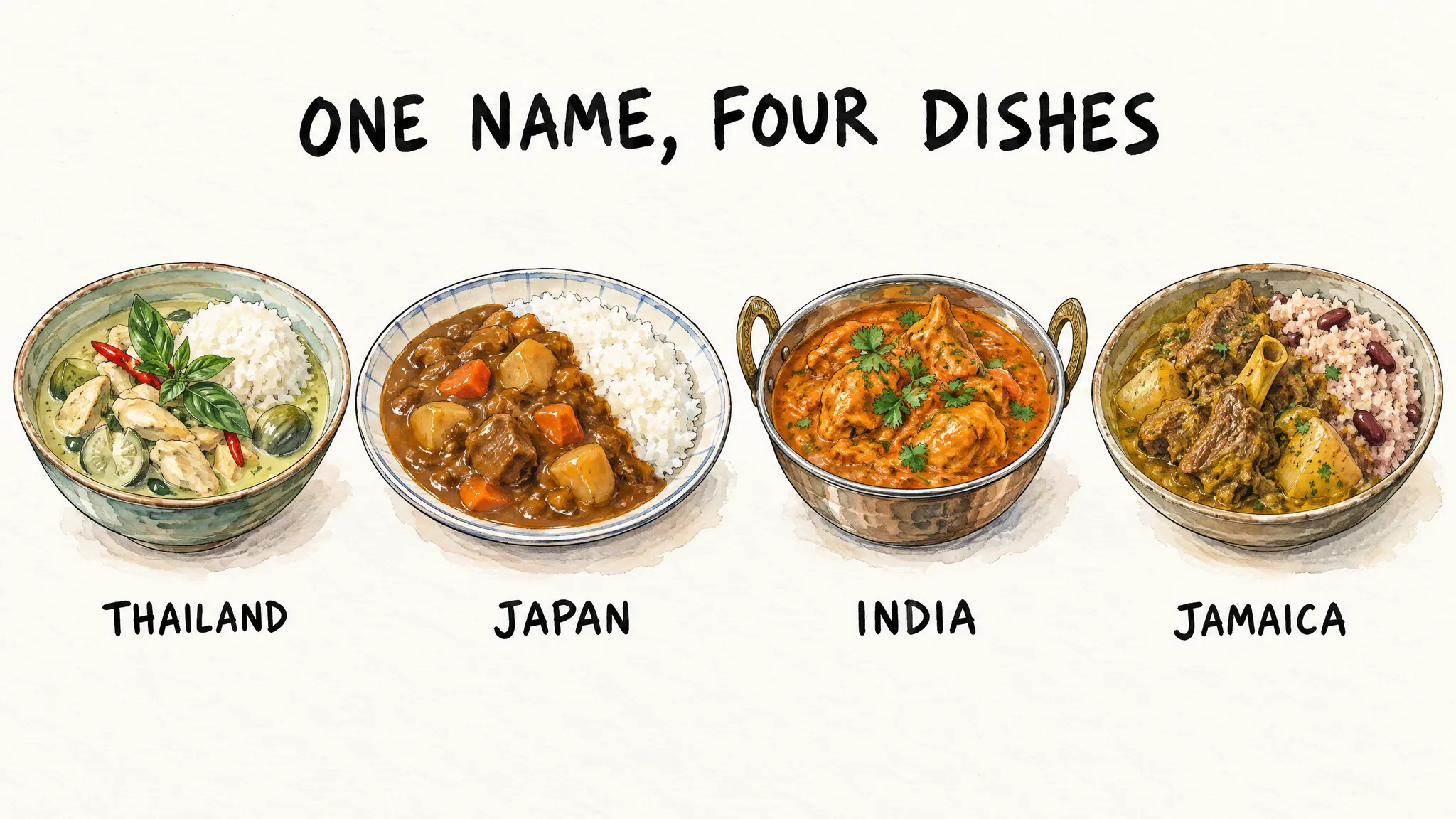
"Curry" is a good example. In Thailand, a green curry is a thin, coconut-milk sauce. In Japan, curry is a thick, roux-based sauce with potato and carrot, served beside rice. In North India, a chicken curry is usually cooked in an onion and tomato gravy. In Jamaica, curry goat is slow-cooked with potato and served with rice and peas. One word, four very different plates.
Even a single dish name travels. Paella in Valencia is traditionally made with chicken, rabbit and green beans, while many restaurants elsewhere serve it with seafood. Texas-style chili usually has no beans, while most other chili does. Cooks in Nigeria and Ghana both make jollof rice, make it differently, and will happily tell you whose is better.
Tracking should make room for that variety, while preserving the identity of dishes such as biryani, jollof rice or pho. Logging jollof as "tomato rice", or pho as "noodle soup", throws away exactly the information that makes an estimate fit: the usual rice, the usual cooking fat, the usual cuts of meat and the usual serving. A dish's name is part of its nutrition data.
2. Regional context helps make sense of your plate
VitalityApp uses country context to help interpret food names and preparation styles. You can also add details about your meal that a picture might not reveal.
How country context works
When you scan a meal, VitalityApp takes the country you're in into account, and reads each food the way people there usually name, make and eat it.
In practice, that means:
- Everyday words take their local meaning. For someone in the UK, "chips" are fries and "biscuits" are cookies. For someone in the US, "chips" come in a bag and a "biscuit" is a soft, scone-like bread.
- Drinks follow local habits unless you say otherwise. If the photo shows a cup of tea or coffee and nothing says whether it's sweetened, VitalityApp assumes it's made the way people in your country usually make it at home. Habits really do differ: milky tea is usually unsweetened in the UK and usually sweet in many other countries.
- Home-style dishes are read as they're usually made where you are. A soup, a stew or a stir-fry is estimated the way it's typically cooked at home in your country, not somewhere else.
- Packaged food is matched to your country's version. The same brand can have a different recipe in different countries. Several soft drinks sold in the UK, for example, were reformulated with less sugar after the UK's sugar levy came in. VitalityApp looks for the version sold where you are, for photos and barcode scans alike.
Where you live isn't what you eat
Regional context provides a starting point; the details you supply make the description more specific. Where you live doesn't determine what you eat. You might cook a family recipe from another country or try something completely new. The food and information you provide remain essential to the analysis.
VitalityApp is built with that in mind:
- Named dishes keep their own recipe. A named dish from another cuisine is read as that dish: Thai green curry eaten in London is still Thai green curry, and paella eaten in Tokyo is still paella.
- What you say comes first. Regional context only fills in what you haven't said. If your note says the coffee is unsweetened, it's logged as unsweetened, wherever you are.
What your note adds
Your note might explain that a curry contains coconut milk, a drink is unsweetened, or a serving is smaller than it appears.
On the photo screen, the Describe your meal (optional) field takes a short note, and VitalityApp reads it together with your photo.
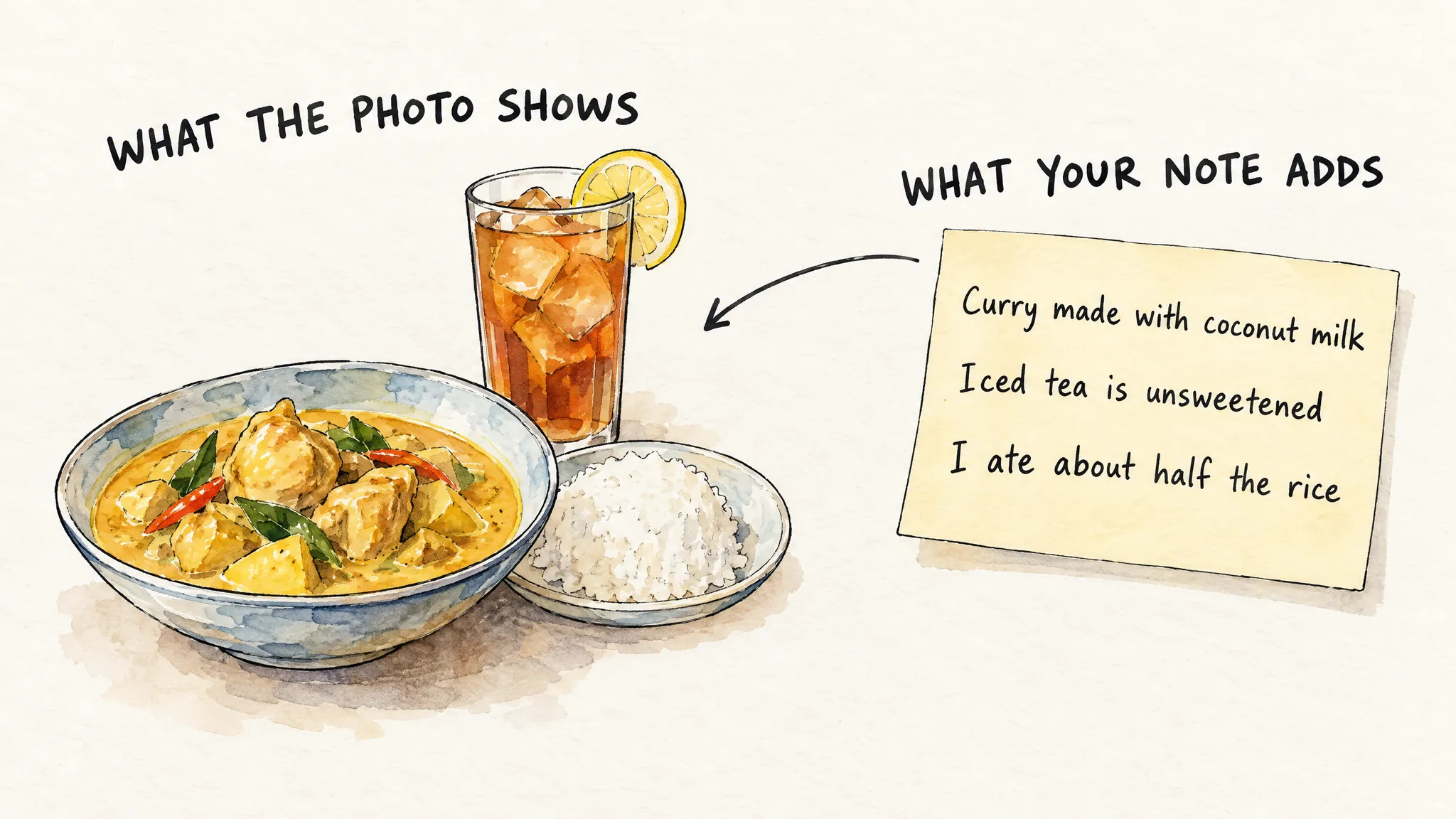
A few words about what the camera can't see do more than a long description of what it can. Some useful things to mention:
| The photo can't show | Try writing |
|---|---|
| The dish's name or style | "Texas chili", "Ghanaian jollof", "Japanese curry" |
| The cooking fat | "fried in 2 tbsp oil", "knob of butter on top" |
| Hidden ingredients | "made with coconut milk", "cream in the sauce" |
| What's in a drink | "unsweetened", "oat milk, no sugar", "2 tsp sugar" |
| How much you ate | "I ate half", "shared between two", "small bowl" |
| What's underneath | "chicken pieces under the rice" |
| Where it's from | "homemade", "restaurant takeaway" |
3. Multiple AI stages work together
Understanding a meal involves several questions: what foods are visible, how much is there, and what nutrition estimate fits those foods and portions?
VitalityApp's AI workflow handles food identification, portion estimation and nutrition analysis across multiple stages. Together, they turn a meal photo into a food log you can review.
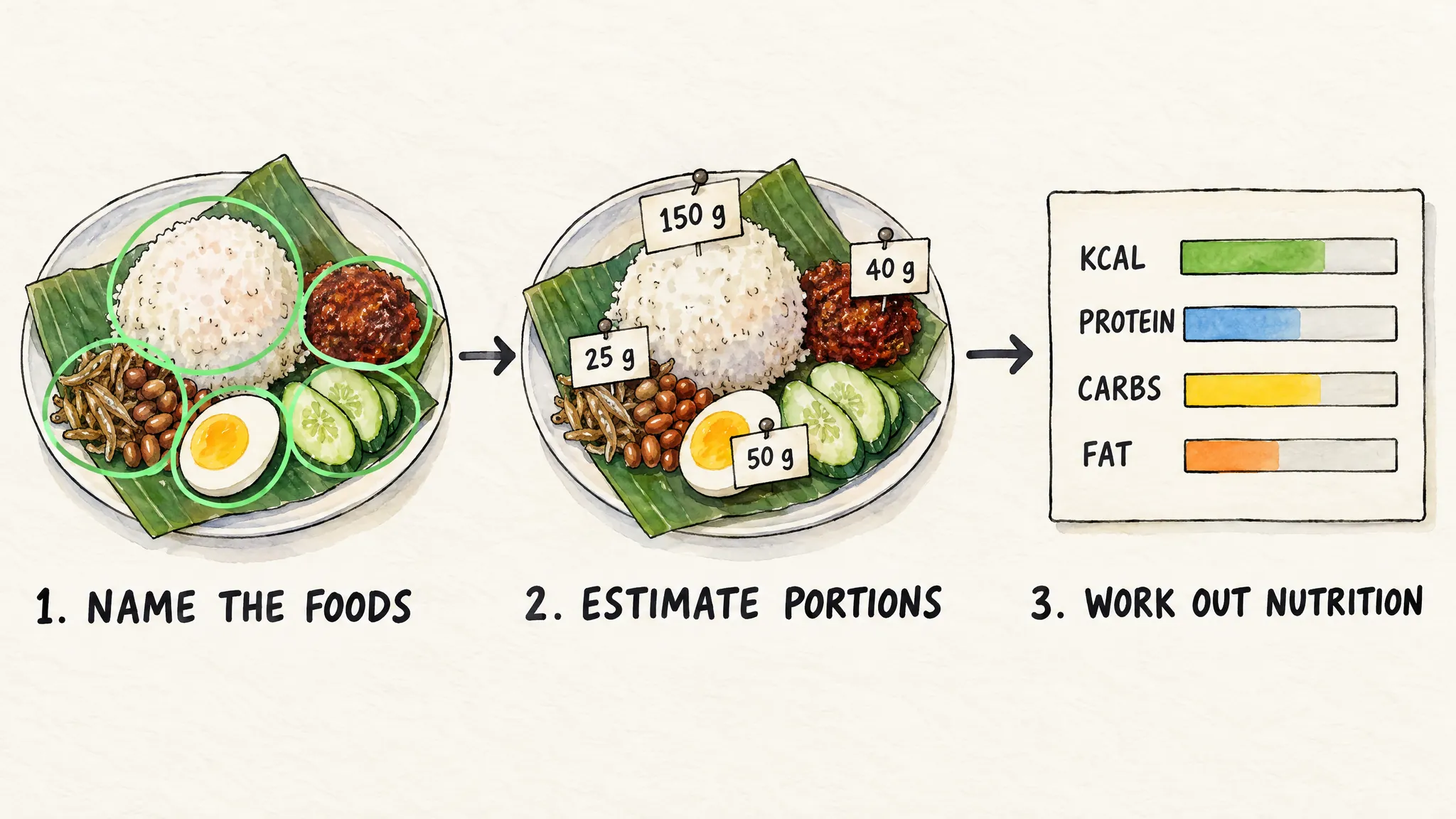
Here's what happens after you tap Analyze Image:
- Identify the foods. Each food on the plate is recognised, along with details that matter for nutrition, such as how it looks to have been cooked.
- Estimate the portions. Each item gets an estimated weight in grams.
- Work out the nutrition. Calories, protein, carbs, fat and fibre are estimated for each item, allowing for what the usual preparation adds, such as frying oil, gravy or dressing. Packaged foods use the product's own nutrition values where they're available.
- You review it. Every food appears on the Review Detected Foods screen with its grams before anything is saved.
This is especially useful for mixed plates, where several dishes contribute to the total. A plate of nasi lemak is coconut rice, sambal, fried anchovies, peanuts, egg and cucumber. A bento box or a table of Korean banchan can hold half a dozen small dishes. Each one is identified, weighed and analysed as its own item, so you can see which part of the plate carries most of the calories, and fix one item without redoing the rest.
Recognising a food is only part of the task; its portion, preparation and accompanying ingredients matter too.
Photos still have limits
Hidden oil, sauces and the depth of a serving can be difficult to judge. Adding details and reviewing the portions helps make your log more representative of what you ate.
- Oil and butter. One tablespoon of oil adds about 120 calories, and once it's cooked into a dish it's almost invisible.
- Sauces, gravies and dressings. Cream, coconut milk, nut pastes and mayonnaise are calorie-dense and mostly hidden.
- Depth. From above, a shallow bowl and a deep one can look the same, though one holds twice as much.
- Look-alikes. Full-fat and low-fat yogurt, regular and diet cola, and sweetened and unsweetened drinks can look identical.
A short note and a quick check of the grams fix most of these. For a closer look at where photo estimates miss, and by how much, see how accurate AI photo calorie counting is.
4. Testing across international foods
We benchmark VitalityApp against a curated mixed dataset covering thousands of items across international cuisines, including foods, drinks, desserts and snacks.
Our internal testing reported a 95% benchmark score across this dataset. We use these evaluations to identify weaknesses and guide improvements across a broad range of foods.
Regional words are a good example of what this testing covers: making sure everyday words like "chips", "biscuits" and "beans" mean what they usually mean where you are, without changing what they mean for everyone else.
That score is an internal evaluation result, rather than a guarantee that every photo will produce exact calories or macros. Individual estimates depend on the meal, image quality and available information. Reviewing the identified foods and portions remains part of the process.
A benchmark score also isn't the same thing as calorie error. A 95% score doesn't mean every estimate lands within 5% of the true calories: a single plate can still be well off, especially when oil, sauces or the depth of a bowl are hidden from the camera.
5. Try it with your own meals
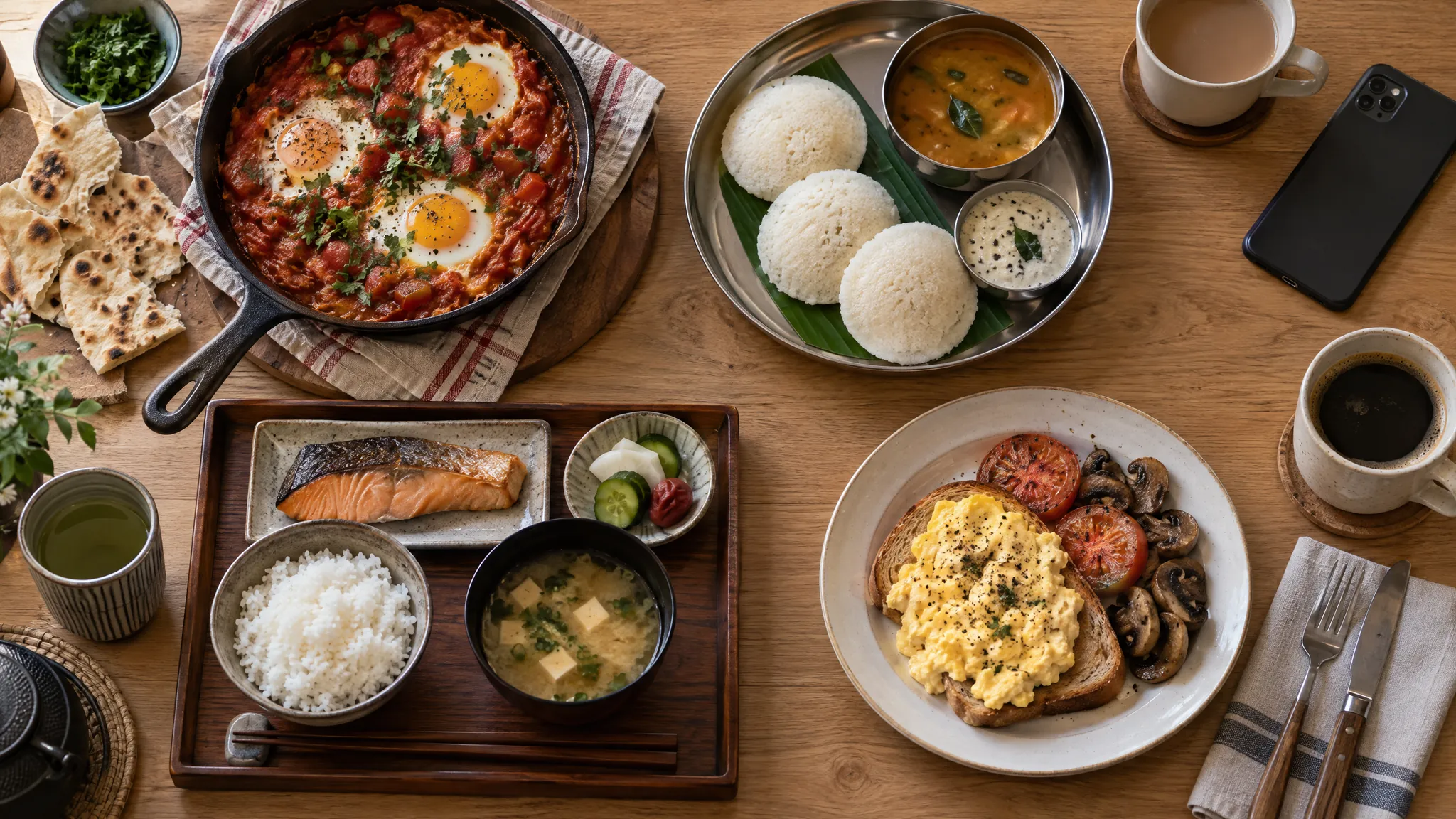
Try your usual breakfast, a homemade lunch or a favourite takeaway. Take a clear photo, add any helpful details, and review how VitalityApp identifies the foods and estimates their portions and nutrition.
To get the most from a scan:
- Take the photo before you eat, in good light, with the whole plate in the frame. Hold the phone at about 45 degrees so the depth of bowls shows.
- Add a note in Describe your meal (optional) for what the camera can't see: the dish's name or style, the cooking fat, what's in the drink, how much you ate.
- Tap Analyze Image.
- Check each item on Review Detected Foods. Change the grams by typing them or with the − and + buttons, and remove anything that isn't on your plate.
- Tap Add to Meal. If it's a meal you eat often, tick Save as a meal, and next time it's one tap away in My Saved Meals.
The free plan includes two scans per month, shared across meal photos, barcodes and nutrition labels. A scan that doesn't find any food isn't counted. Plus raises the limit to up to 50 scans a day.
Typing and voice logging are free on every plan, with a fair-use limit of 50 AI food searches a day, and they use the same country context. For a home-cooked meal you know well, "chicken stir-fry with rice, cooked in 1 tbsp oil" is as quick as a photo.
Food is personal, varied and global. Nutrition tracking should make space for that.
Try VitalityApp with the meals you actually eat.
Frequently asked questions
What if I'm eating food from another country? Name the dish in your note, such as "Japanese curry" or "Ghanaian jollof". A named dish from another cuisine keeps its own recipe, wherever you are.
What if my family makes a dish differently? Say so in the note: "with coconut milk", "no potato", "cooked in olive oil". What you write comes before any regional assumption.
What about packaged food? Scan the barcode, and VitalityApp looks up your country's version of the product. To add a product from its label, use Scan label when you create a meal in My Saved Meals, and VitalityApp reads the values printed on the nutrition table.
Are my meal photos saved? No. A photo you scan to log a meal is sent for AI analysis, and only the foods it finds are logged to your account.
Can I log a meal without a photo? Yes. Type or say what you ate. Typing and voice logging are free on every plan.
Keep reading
- How accurate is AI photo calorie counting?: where photo estimates hold up, where they miss, and how to get closer numbers.
- AI calorie counter: logging by typing, voice, photo, barcode and label in VitalityApp.
- Introducing VitalityApp: what the app does and who it's for.
- Food and nutrition basics: macros, portions and how to build a balanced plate.